Market day at its height, with the Bartlett fountain raised on its flight of steps above the heads of the crowd. Look at how many people are wearing hats — nobody came into town bare-headed. For most families in the Gorge this was the weekly shop, the news and the gossip all in one. Early 1900s.Early 1900s
Looking up from the foot of the Market Place towards the Commercial Hotel, with the fountain commanding the entrance to the Square. Before traffic took over, this was the town's principal meeting place — you came here to trade, to drink and to hear what had happened. Exact date unknown.Early 1900sLooking across the Market Place towards the Tontine, the railed fountain on the left and a horse-drawn cart waiting on the setts. The road surface is the giveaway: no kerbs, no markings, just open ground shared by carts, stalls and pedestrians alike. Colourised; exact date unknown, but firmly the horse age.Early 1900sColourised.
The Square with Bates & Hunt, chemists, and the arcaded market building running away beyond. The chemist's window display is worth a second look — patent medicines were sold here long before the National Health Service reached the Gorge. Exact date unknown.Early 1900sThe Square after the war, with cars drawn up on the very ground where stalls once stood. It happened quietly, a vehicle at a time, until the market had nowhere left to spread. This is the turning point in the Square's story caught almost by accident. Exact date unknown.Around the 1950s
Ironbridge Market Square – Butter, Chemists, and Change
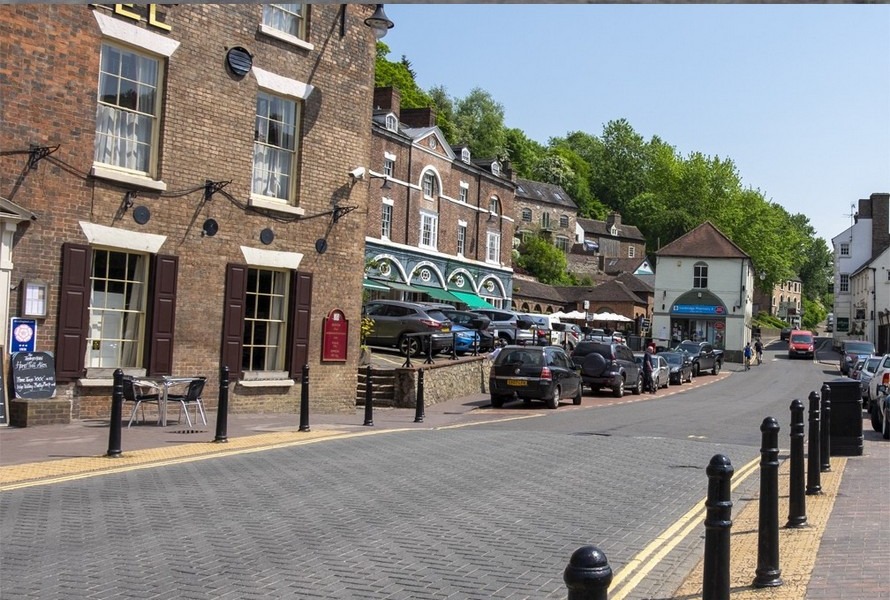
On a summer afternoon the foot of Tontine Hill is cafés, parked cars and people drifting towards the bridge. For most of its life it was something else entirely: the place the whole town came to on a Friday.
The Square
The Iron Bridge opened in 1781 and trade shifted down to the riverside. The old Madeley market was moved here into a new Georgian Butter Market, built to give the growing settlement a commercial centre. Everything on this page happened within a few dozen paces of that spot.
The Butter Market
A crowd pressed against the great brick arch, with carts and livestock in the foreground — one of the earliest photographs in the collection. The long exposure has blurred the animals, which is how we know they were shifting about. Ironbridge's market handled beasts as well as butter. Exact date unknown.Late VictorianOne of the earliest photographs in the collection.
Stalls packed in below the fountain steps, canvas awnings pulled out over the goods. Notice how the traders have used the slope of the Square — the steps make a natural grandstand, and children always ended up sitting on them. Ironbridge held its market here for well over a century. Exact date unknown.Early 1900sA printed commercial postcard, "Market Place (Market Day), Ironbridge" — proof that the market was considered a sight worth sending home. The tinting is hand-applied, so the colours are the printer's guesswork rather than the truth. Postcards like this carried the town's image across Britain. Exact date unknown.Early 1900sHand-tinted commercial postcard.
By the 1960s the stalls were squeezed into whatever space the parked cars left them, trestles set almost against bumpers. It is a small detail with a large meaning: the market was no longer the reason the Square existed, merely one of the things happening in it.1960sMarket day in the 1970s, a delivery van pulled up tight against the stalls. Goods now arrived by road rather than by cart or river, and the van doors double as the back of the stall — a practical fix traders across Shropshire adopted.1970sA clothing stall under its awning, garments hung on rails at eye height so shoppers could feel the cloth before buying. Ready-made clothes at market prices were how most families in the Gorge dressed. Exact date unknown, though the styles suggest the middle of the twentieth century.Mid 20th century
Shoppers gathered round the fruit and vegetable crates, headscarves knotted and winter coats buttoned. The produce is still in its wooden transit crates — no packaging, no refrigeration, just what had come in that morning. Exact date unknown, but the dress places it in the post-war years.Mid 20th centuryA busy market morning with awnings run out along the whole length of the Square. Follow the line of canvas and you can see just how far the stalls once reached — right across ground now given over to parking. Colourised; exact date unknown.Early 1900sColourised.
The line of brick arches along the far side was the Friday market — butter, cheese, eggs, poultry and vegetables, sold under cover so traders and perishables stayed dry. Arcades of this kind were common in Georgian market towns, and they were designed for exactly that sort of produce.
The Square
By the nineteenth century the market had grown well beyond dairy. Fruit and vegetables, fish, bread, household goods, tools and textiles all had their pitch, and traders came in from Coalbrookdale, Broseley and Madeley — which is why older accounts still call it the "Madeley market" long after it left Madeley. In the early twentieth century locals remembered hardware, crockery and second-hand stalls among the food, with travelling salesmen setting up carts wherever there was room.
The Square
The decline came slowly. By the 1950s and 60s the shops had taken most of the trade, cars and buses wanted the ground, and the open-air market shrank until it was pushed out altogether. The arches remained. Some were infilled or adapted over the years, but the footprint of the old Butter Market can still be traced along the frontage.
Market buildings – the row of shops through time
The arches, open then enclosed
The arcade began as an open market range. Photograph by photograph the openings are filled in, lettered and painted, until only their shape remains.
01
The arcade lettered "Printers Stationers" and "Slater & Co", with the Post Office working out of one of the arches. Each arch held a different trade, which is why the frontage carries so many names at once — a small indoor high street. Exact date unknown.Early 20th century
02
Market day below the same frontage, N Doxon and V & E Shaw signed over two of the arches and Lloyds Bank standing to the left. Trade spilled straight out of the arches onto the stalls in front — shop and market were one business, not two. Exact date unknown.Early 20th century
03
The run of arches in deep green and cream, the Post Office at the near end. Painting the whole range in one colour scheme made a Victorian market building look like a modern parade of shops — a common bit of mid-century tidying up. Exact date unknown.Mid 20th century
04
The arcade in green and white with the Square nose-to-tail with parked cars. There is barely a yard of clear ground in the picture, which is precisely the problem the 1975 conservation report set out to solve. Exact date unknown.1960s–70s
05
The arcade today in pink and cream, with The Book Nook, Ironbridge Book Shop and Moonshine & Fuggles trading under the arches. Different names, same openings: the building has simply kept finding new tenants for two centuries. Present day.Present day
Courtyard Cafe under the brick arches, with Nick and Jenny behind the counter. The arches sheltering the tables were built for market traders, not for coffee — the building has changed its use without changing its shape. Present day.Present dayThe old market arcade seen from the courtyard, its brick arches now home to The Courtyard cafe. An open archway gives directly onto the paving, a modern use that still follows the old market rhythm: the space that once supplied traders now serves visitors. Late 20th century.Late 20th century
One row, two centuries, and a new name over the door most generations.
It began in the 1790s as an open arcade for butter, cheese, eggs, poultry and veg, the arches later filled in to make permanent shopfronts. By the early twentieth century one of them is clearly signed "Café" — refreshment arriving alongside the produce.
The Square
Between the 1930s and the 50s the big pediment above read "PRINTERS • STATIONERS", with SLATER & CO on the upper fascia. Sharing the same ground floor were N. Dixon, likely a draper or clothier, and P. B. Shaw, a haberdashery kept by two ladies known to everybody as the Miss Shaws.
The Square
In the 1960s the printing and stationery trade continued under the Wozencroft name: the place for school books, pens, posters and duplicating. A decade later the signs read Ironbridge Antiques, and C. Ellis, greengrocers, run by Charlie Ellis — everyday essentials giving way to antiques and speciality produce. From the 2000s the arches went to independents again, with The Ironbridge Bookshop and The Book Nook next door.
Not everything here belongs to the past. Bears on the Square, in a Grade II listed 1791 building close to the Iron Bridge, has spent more than thirty years becoming one of the UK's best-known teddy bear shops, drawing visitors from the other side of the world to a row built for butter.
Pharmacy
One corner, five lifetimes
Williams the chemist, the yellow R. L. Williams years, Picasso's Hair Design, and the pharmacy and Post Office of today.
01
Williams the chemist, lettered "THE PHARMACY — WILLIAMS M.P.S." across the fascia. This is the same Market Hall building that houses the pharmacy today, seen at an earlier stage with a different shopfront and painted sign. Note the low stone wall at the left, still there now. Exact date unknown.Mid 20th centuryThe same Market Hall building as today, with an earlier shopfront.
02
The same shop, now painted yellow and lettered "THE PHARMACY — R. L. WILLIAMS M.P.S.". The parking meter at the kerb is the detail that dates it, and the van beside it agrees: this is Ironbridge in the 1960s or 70s, learning to live with the motor car.1960s–70sDated from the van and the parking meter.
03
Picasso's Hair Design in the arched corner building, its infill panels picked out in green. Every arch has been blocked, yet the arcade's rhythm still reads plainly across the frontage — once you see the curves above the windows you cannot unsee them. Late twentieth century.Late 20th centuryEvery arch is blocked, but the arcade's shape survives intact.
04
The same corner today, trading as Ironbridge Pharmacy & Post Office. Stand back and count the arches: the shape of the old market building is unchanged beneath the modern shopfront. Few buildings in the Gorge have carried on serving the town so continuously. Present day.Present day
05
The shopfront tucked under its arch — Ironbridge Pharmacy above, the Post Office below. Two of the services a small town cannot do without, sharing one Victorian opening. The brickwork around the arch is original; only the glass and signage have changed. Present day.Present day
The Post Office arch in its green livery, the oval window sitting neatly above the doors. That oval is original market fabric, not a later flourish, and it survives above the shopfront today. For decades this arch was where the Gorge collected its pensions and posted its letters. Exact date unknown.Mid 20th centuryThe corner building with the long arcaded range of the old Butter Market alongside it. Seen together like this, the two read as one structure again, which is exactly how the market worked: covered trading under the arches, open selling in the Square. Present day.Present day
The corner building has had more identities than most, and the paintwork to prove it.
It started as part of the Butter Market and was later adapted into a chemist's shop. In the nineteenth century its arched opening faced straight out across the market place; photographs from the late Victorian and Edwardian years show the arch open and prominent. By the middle of the twentieth century it had been bricked in, and Williams' Pharmacy had the keys.
The Square
In the 1960s the sign read "The Pharmacy, Williams M.P.S.", the shopfront looking directly down the Bank. By 1969 R. L. Williams had taken over and painted the whole thing a bold yellow, a colour older residents still remember. The last day of Williams' trading in Ironbridge was Saturday 2 August 1969, before the business moved to Wensley Green, Woodside.
The Square
The shop then became Ironbridge Pharmacy, and in 2013 the Post Office moved in from next door, where it had been in the premises now known as Moonshine & Fuggles. Immediately left of that old Post Office was a hardware shop run by Mr Branford, then a fishing tackle and bait shop in 2007, and later The Ironbridge Bookshop at No. 5.
The Square
Behind, the infilled section was a hair salon for many years and has housed Donutology since September 2022, while the main shop carries on as a pharmacy with the Post Office. The colours keep changing: yellow in the 1960s, green around the 2000s, cream with red detailing today. The outline of the old arch is still visible in the brickwork.
The Bartlett Fountain – a forgotten gem
The Bartlett memorial obelisk raised on its steps at the front of the Square. It was built to give people clean drinking water at a time when that was far from guaranteed in the Gorge — a memorial that did a job as well as marking a name. Exact date unknown.Early 1900sThe obelisk standing above the Square with shops and awnings ranged behind it. Its height is deliberate: on market day you could find it over the heads of the crowd, which made it the obvious place to arrange to meet. Exact date unknown.Early 1900sThe obelisk still in its place, with the first motor cars drawn up along the wall beside it. Two ages sharing one photograph — the Victorian drinking fountain and the vehicles that would eventually push it to the edge of the Square. Exact date unknown.Inter-war years
Newspaper report on the Bartlett Memorial Fountain, reproduced as documentary evidence.Press cutting, date unknownThe suggested attribution of the design to John Bell remains a research theory; no documentary proof has yet been found.
For a century the tallest thing in the market place was not a building at all.
The Reverend John Bartlett became vicar of Buildwas in 1823 and lived at Marnwood, just outside Ironbridge. What troubled him was the water: townspeople were drinking straight from the Severn at a time when sewage was being tipped into it. He married Susanna Ball Reynolds, daughter of William Reynolds, one of the great Quaker ironmasters of Coalbrookdale, and after his death in 1861 Susanna paid for a red granite drinking fountain in his memory, raised here the following year.
Local accounts have long disagreed about where its water came from. The newspapers of the day settle it:
February 1862 (Shrewsbury Chronicle): Bartlett was praised for supplying water to Ironbridge at his own expense, and a memorial fountain was being planned by his widow.
July 1862 (Wellington Journal): the fountain was unveiled in Ironbridge Market Square with hymns, a children's procession and a hand-over by Mrs Susanna Bartlett. The water supply came, through the kindness of Mr Darby, from the Strethill grounds via iron pipes.
April 1863 (Shropshire & Montgomeryshire Times): after townsfolk asked for a "more convenient and important site", Mrs Bartlett agreed, and the fountain was moved within the Square to the centre of the steps beside the Tontine Hotel.
In short: erected in 1862 by Mrs Susanna Bartlett in memory of Rev. John Bartlett, fed from Strethill rather than Marnwood, through the kindness of Mr Darby — a widow's memorial that doubled as a public health measure.
Removal, and the campaign to bring it back
The fountain today, railed off above the Waterloo Street car park. It stands a little apart now, easy to walk past without noticing, yet it is the same monument that once presided over market day. Look for the worn stonework at its base. Present day.Present day
Then came the buses. When Telford Development Corporation restructured the Square for them in the 1960s, the fountain was judged to be in the way. It was dismantled and re-erected in a car park behind Waterloo Street, where it still stands among benches and planted borders looked after by the Gorge Green Gang.
The Square
It may not stay there. A campaign is raising around £40,000 to bring it back as a working fountain with a seating area, though not as an exact copy: the surrounding steps and pedestals will not be reinstated. Ground investigations into relocating it were carried out in September 2022.
Lloyds Bank Limited on the Square, cars packed nose-in along the frontage. A branch bank here says a good deal about the town's confidence: money, as well as market produce, changed hands in this corner of Ironbridge. Exact date unknown.Mid 20th centuryThe former bank building today in cream and grey, standing above the parking bays. The proportions are unchanged — tall ground-floor windows built to look solid and reassuring, as bank frontages always were. Present day.Present day
Every market town needed somewhere to bank the takings. That job fell to this handsome corner building, put up in the late 1700s and now Grade II listed, its ground floor remodelled with a proper bank-style frontage in the late nineteenth century.
The Square
1874: Lloyds bought the building.
1891 (Kelly's): Edward Montagu Webster listed as Lloyds manager.
1916: Lloyds Roll of Honour includes John Leslie Dain, "Lloyds Bank, Iron Bridge."
1983/84: ceased bank use and became a shop.
1990s: converted into flats, "Lloyds Bank Chambers."
Today: ground floor is Severn Hospice Shop, Ironbridge's only charity shop.
A name on a war memorial, a manager in a directory and a hospice shop window — all from the same doorway.
1971 redevelopment
A visual feature
From Market Place to Car Park… and Back Again
Stalls and shoppers give way to saloon cars and bus bays, the Development Corporation draws up its plans, and the Square edges back towards people on foot.
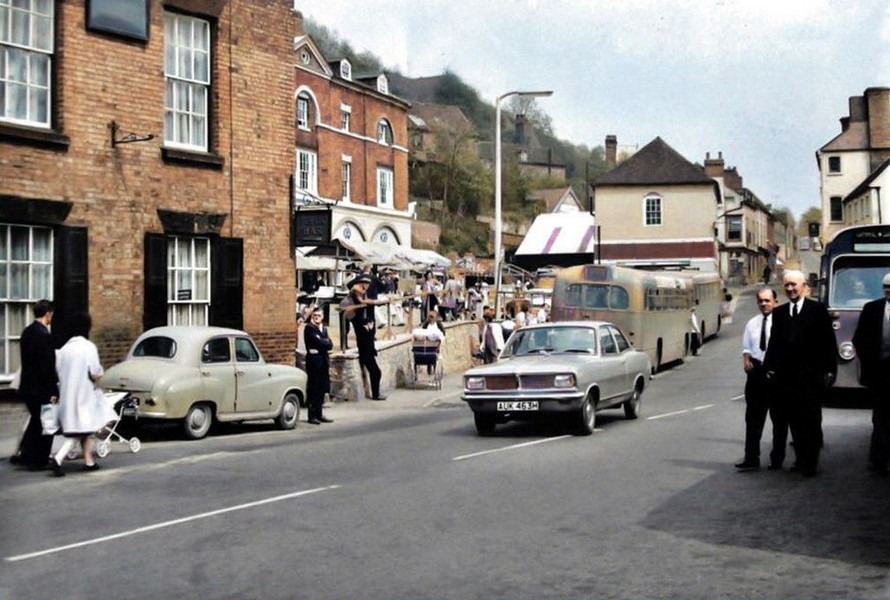
The Square in its bus-station years, saloon cars nosed in around the obelisk. This was the moment the space changed job: from a place where people stopped and traded to a place where vehicles waited. The 1950s and 60s did that to a great many market towns.1950s–60sBuses drawn up below the wooded bank at the Ironbridge terminus. For anyone without a car — which was most people — this was the way out of the Gorge to Wellington, Shrewsbury and work. Exact date unknown.Mid 20th centuryA Telford Express coach at M H Elcock & Son, with Lloyds Bank and Ironbridge Antiques behind. The antiques shop is the telling detail: by the early 1970s the Gorge was beginning to sell its own past to visitors. Early 1970s.Early 1970s
The Square seen from above in the 1970s, coaches at the terminus and every spare yard given over to parking. From this angle the loss is obvious — the open market ground has vanished under vehicles, and the case for change makes itself.1970s
"Ironbridge '75", Telford Development Corporation's report and proposals for the conservation area. A modest-looking document, but it set the direction for everything that followed — including the removal of the buses from the Square. 1975.1975The Objectives page of the 1975 report, illustrated with the Square packed tight with cars and buses below the Tontine. The planners chose that photograph deliberately: it was the argument, printed alongside the words. 1975.1975Central area improvement: the 1975 plan and proposals for a pedestrianised Market Square. Trace the drawn lines against the Square as you see it now and much of it was actually built — one of the rare cases where the plan on paper came true. 1975.1975
ThenNow
Tontine Hill and the Square: buses at the terminus, and the same view today with the stalls back in place. Drag to compare.
Planners took their own view of the place in 1971. Redevelopment proposals stressed the importance of realigning the Bank and the High Street, and recorded how the uses of the old Butter Market buildings had drifted from their original purpose.
Much was adapted, some of it clumsily, but the Square went on doing what it had always done: gathering, trading and remembering.
Still standing
The arcade today in pink and cream, with The Book Nook, Ironbridge Book Shop and Moonshine & Fuggles trading under the arches. Different names, same openings: the building has simply kept finding new tenants for two centuries. Present day.Present dayThe shopfront tucked under its arch — Ironbridge Pharmacy above, the Post Office below. Two of the services a small town cannot do without, sharing one Victorian opening. The brickwork around the arch is original; only the glass and signage have changed. Present day.Present day
Those arches are still earning their keep. Café, then Slater & Co, then Wozencroft, then Antiques and C. Ellis, then the Post Office, then Bears on the Square: one row of openings, changing hands for more than two hundred years, from butter and books to lattes and donuts.
Very little about this corner has stayed settled for long, and that restlessness is as much a part of its history as the brickwork.