Ironbridge
Fords and Ferries in Ironbridge
Crossings of the Severn Gorge
The River Severn has always been both a barrier and a lifeline, and nowhere more so than in the Ironbridge Gorge.
For centuries, before the great iron and stone bridges spanned the valley, people relied on shallow fords, ferries, and even coracles to cross its fast-flowing waters.
Each crossing had its own landing stages, ferrymen, and stories — tales of daily toil, family traditions, and the ever-present danger of the river itself.
By the 20th century almost all ferries had disappeared, replaced by permanent bridges, but the memory of these precarious crossings is still deeply woven into the history of the Gorge.
The Fords
The earliest crossings were fords.
Known sites included Buildwas, where there were two, Dale End (opposite where the Museum of the Gorge now stands, crossing towards the later railway viaduct), Coalford, and Gitchfield.
Gitchfield Ford lay further downstream towards Madeley Wood, on a shallower reach of the river between Coalbrookdale and Jackfield; like the others, it was only passable in low water and was hazardous in flood.
A report from 1762 describes a wagon toppling into the river while attempting to use the Dale End ford, showing the dangers even in the 18th century.
The Ferries
By the 17th century at least six ferries were operating along the Severn Gorge between Buildwas and Coalport.
These included Buildwas Ferry, the Meadow Ferry (sometimes known as Benthall Edge), Benthall Ferry at the later site of the Iron Bridge, Jackfield Ferry, the Lloyds Horse Ferry, and the Tuckies Ferry at Coalport.
Each had its own ferrymen, cottages, and stories, passed down through generations.
Buildwas Ferry was among the oldest crossings, linking Buildwas village with the opposite bank.
It was eventually replaced by Buildwas Bridge in 1796, but remained in use into the 19th century.
The ferry house stood as a local landmark.
In January 1916, ferryman William Bird drowned while fastening his boat during a flood, showing how dangerous the river remained even after centuries of use.
The ferry ran from the three cottages beneath Benthall Edge on the south bank (later demolished to make way for the Power Station cooling towers) across to the north bank by the Valley Hotel and the Ironbridge Rowing Club.
Tickets were originally sold in a small office in the Valley Hotel grounds.
Later, the hut was moved into the Beddoes family’s private garden at Bower Yard. Though it is now part of a private residence, the hut can still be seen if you walk along Bower Yard — one of the last physical survivals of the Gorge ferries.
Martha “Granny” Wale operated the ferry around 1904.
In a well-documented incident she was crossing with her grandchildren when the boat slipped.
All were tipped into the river, but she clung to the guide wire and, waist-deep in the Severn, dragged the children to safety — remembered locally as a “marvellous escape.”
Beddoes was as much a local character as he was a ferryman.
Known affectionately as “Boats”, he not only worked the punt but also hired out rowing boats to locals and visitors.
His daughter Florrie grew up in the cottages, with the rhythms of ferrying and boat-hire forming part of everyday life.
Another memory, from PJ Humphreys of Shrewsbury, described travelling as a 4-year-old in 1938–39: the ferry was a punt hauled hand-over-hand along a wire stretched across the river.
Humphreys remembered his grandmother shouting across the water, George rowing over to fetch them, and the thrill of crossing when the Severn was running high.
The fare was remembered as a halfpenny each way.
Children especially recalled the sense of adventure, and the fact that the ferryman would often come only when hailed from the opposite bank.
The ferry’s setting was lively.
Opposite the cottages stood the Ironbridge Rowing Club, and next to it the Regatta Field, where local carnivals and jazz band contests were held.
The Grand Hall, built by the Coalbrookdale Company in the 1920s as a social club, also stood nearby.
Together they made the ferry not just a utility but part of a riverside scene alive with leisure and community.
The cottages were demolished when the power station was built in the 20th century, but the ferry itself carried on working into the 1950s, making it the last operational ferry in the Ironbridge Gorge.
This ferry was a well-used crossing long before the idea of building a bridge was ever raised, and for much of the 17th and 18th centuries it was one of the main ways workers, traders, and families moved between Madeley/Benthall and Coalbrookdale.
This ferry was significant enough that when Abraham Darby III began planning a permanent bridge in the 1770s, he chose the very site of the Benthall ferry landing.
The construction of the Iron Bridge (opened in 1779) made the ferry instantly redundant.
Although little survives in terms of photographs or physical remains, there are strong indications that the ferry was still active right up until bridge works began.
Early travellers’ accounts describe small flat-bottomed punts being worked across at this point, and some early maps still mark a ferry landing.
The Jackfield Ferry was among the oldest in the Gorge.
The Dog & Duck Inn, a long half-timbered building dated 1654 for Adam and Margaret Crumpton, stood right by the landing stage.
The Dog & Duck’s licence was not renewed in 1892, after which the building remained as cottages.
The Crumptons were known ferrymen as early as 1680, and in the 1851 census William Crumpton appears as “proprietor of ferry boat.”
Through marriage, the Balls, Williams, Evans, and Oswells families also became connected to the inn and the ferry.
By the late 19th century Joseph and Mary Oswell were in charge; after Joseph’s death in 1894, Mary ordered a new ferry boat from a builder in Jackfield.
Around 1908–09 the ferry was worked by Francis “Frank” Poole alongside William Harrison, landlord of the Black Swan.
Harrison’s father John had drowned in 1900 while lighting the ferry’s oil lamp, swept away by the current and found weeks later near Bridgnorth.
Frank Poole became one of the last ferrymen here.
Born in 1883, he was remembered as a man of many trades — steeplejack, undertaker, master builder, coracle-man, and ferryman.
His family recalled him rowing relatives across the Severn in a coracle, dog included, though none of them could swim.
In 1909, the opening of the Free Bridge just upstream made the ferry redundant almost overnight.
Cheap, safe, and toll-free, the bridge drew away every passenger.
Poole soon turned to other work, while the ferry faded into memory.
The Dog & Duck itself lingered as cottages before being demolished in 1940.
This was one of the larger ferries, capable of carrying not just passengers but also horses and carts across the Severn.
It served the industries at the Lloyds and nearby communities.
Once the Free Bridge opened in 1909, the horse ferry became unnecessary and soon disappeared.
Perhaps the most historically significant, the Tuckies Ferry connected the Boat Inn at Jackfield with Coalport near the Tar Tunnel.
It was essential after John Rose moved his china works from Caughley and Broseley to Coalport, carrying workers back and forth.
It is remembered above all for the disaster of 23 October 1799.
In thick fog and flood, a ferry boat carrying 41 passengers capsized.
Twenty-eight people drowned, including eleven children.
Three bodies were never recovered; others were found downstream months later.
John Rose personally provided coffins and support for bereaved families, and was “frequently seen to shed tears.”
Many victims were buried at the Red Church, St Mary’s, Jackfield.
In 2019, a 220th-anniversary memorial was held.
Despite the tragedy, the ferry continued.
In 1890, Joseph Crowell, landlord of the Boat Inn, bid £63 for the rights to run it.
In 1907 ferryman Levi Doughty wrote to the press, warning he might stop operating because the landings were unlit and unsafe; another letter urged the building of a footbridge.
That appeal was finally answered in 1922, when the Jackfield Memorial Footbridge opened and the ferry ceased.
Before any bridge spanned the river at Coalport, there was a ferry at Preens Eddy, also known as the Woodbridge Ferry.
This was one of the Gorge’s older crossings, carrying workers and traders between the Broseley side and Coalport/Blists Hill side.
In 1780, a timber bridge known as the Wood Bridge was built at the same spot to replace the ferry.
It was a bold attempt at a permanent structure, but the design was short-lived: within a few decades it decayed badly under the Severn’s floods and constant wear.
Because of that, the Wood Bridge was replaced by the present Coalport Bridge in 1818 — a cast-iron structure that still stands today.
The ferry itself disappears from records as soon as the wooden bridge was in place, but its importance was that it fixed Preens Eddy as the key crossing point for that stretch of the Gorge.
Coracles
Alongside the official ferries, many locals crossed the river in their own coracles — small, round, tarred boats, light enough to be carried home on a man’s back.
They were a long-standing tradition on the Severn, used for fishing as well as for quick personal crossings.
Families would keep them in sheds or lean-tos along the riverbank.
One such shed still survives today on the south bank near the Iron Bridge.
Weathered but intact, it is one of the last physical survivals of the Severn coracle tradition.
It reminds us that while ferries had timetables, fares, and ferrymen, the coracle was for private and often precarious crossings — a man’s boat on his back, launched whenever the need arose.
Stories of coracle use show both the danger and the ordinariness of life on the Severn.
Frank Poole of Coalport, remembered also as a ferryman, steeplejack, and undertaker, would take his family across in a coracle, with his children, wife, and even the family dog aboard.
None of them could swim, but they trusted the light tarred frame to get them over.
Even after the ferries closed in the early 20th century, coracles remained tied to the Gorge’s identity.
Today, the Ironbridge Coracle Trust preserves that history, keeping alive a craft that once made the Severn both a working river and a lived-in one.
The Bridges that Replaced the Ferries
By the early 20th century the ferries were obsolete, replaced by permanent structures:
- Iron Bridge (1779) – replaced the Benthall Ferry.
- Wooden Bridge at Preens Eddy (1780) – replaced the Preens Eddy ferry; itself replaced by Coalport Bridge.
- Buildwas Bridge (1796) – replaced the Buildwas Ferry and fords.
- Coalport Bridge (1818) – replaced the failing Wooden Bridge.
- Free Bridge (1909) – replaced Jackfield Ferry and the Lloyds Horse Ferry.
- Jackfield Memorial Footbridge (1922) – replaced the Tuckies Ferry.
By then, only the Meadow/Benthall Edge ferry lingered on, finally closing in the 1950s.
Its cottages are gone, its ferrymen long passed, but its story — and the stories of every crossing — still hangs over the waters of the Gorge.
More Gorge history
Read another story
The archive
The crossings, photograph by photograph
Forty-six catalogued images, five documents and every recorded crossing on the river, gathered here in one place. Click any photograph to open it full screen and zoom in.
Where the crossings were
Filter by type and select a crossing to see what the archive holds for it.
Schematic — positions are ordered upstream to downstream, not to scale. Source: Broseley Local History Society, February 2010.
Select a crossing on the map to read about it.
Benthall Edge Ferry
The best-recorded crossing in the Gorge: a boat hauled across on a wire rope for a ha'penny, worked by Granny Wale and then by George Beddoes.
Benthall Edge Ferry
About 1905
Here the Benthall Edge ferry hauls across on its wire rope, the ferryman's cottage tucked below the slope and the Edge rising steeply behind. Look closely and you can spot the taut rope cutting the water. Published around 1905 as a postcard titled 'Benthall Edge Ferry', it shows a crossing used daily by workers long before any road bridge existed here.
Published postcard, photographer unknown
Benthall Edge Ferry, colourised
About 1910
This hand-tinted postcard, made around 1910, shows the same Benthall Edge crossing from a gentler angle: a rowing boat drawn up in the foreground and stone steps cut into the bank on the Ironbridge side. Those steps, worn smooth by generations of boots, are easy to overlook but were the crossing's only real infrastructure for well over a century.
Colourised postcard
Waiting at the ferry landing
Early 1900s
A knot of passengers waits patiently at the stone landing steps of the Benthall Edge crossing in this real photographic postcard from the early 1900s. The ferry itself ran on a wire rope stretched bank to bank, with the ferryman hauling it hand over hand — a simple, tiring method that kept the crossing running for generations of local workers.
Real photographic postcard
The crossing beneath the Edge
About 1910
The steep, wooded flank of Benthall Edge towers over this tiny river crossing, photographed and tinted around 1910. Hidden among the trees on the far bank were limekilns and quarry tracks, industries the ferry quietly served alongside its passenger trade. It's a reminder that even the most scenic Gorge views often masked hard, ongoing industrial work.
Colourised postcard
Landing steps and rowing boat
Early 1900s
A single rowing boat sits moored beside the stone landing steps in this early 1900s photograph. Steps like these — narrow, uneven and treacherous when the river was in flood — were, remarkably, the only infrastructure most Gorge ferries ever received, a stark contrast to the grand bridges built elsewhere along this same stretch of river.
Archive photograph, photographer unknown
A mother and children at the ferry landing
Early 1900s
A mother and her children pause at the ferry landing in this early 1900s photograph, waiting for the boat that will carry them across. For hundreds of Gorge families the ferry wasn't a novelty but a daily necessity: a ha'penny each way bought passage to work at the tileworks, the foundry or the pit on the opposite bank.
Archive photograph, photographer unknown
Granny Wale, ferrywoman
Late 19th century
Known locally simply as Granny Wale, this ferrywoman worked the crossing in the late 19th century, before George Beddoes eventually took over the licence. Ferrying in the Gorge was often a family trade passed down through generations, and — as this portrait shows — frequently worked by women who knew the river's moods as well as any man.
Family photograph, contributed
The ferry shed today
Modern photograph
Photographed in the present day, this corrugated-iron shed over a timber frame is one of the last physical traces of the ferry crossings still standing on the riverbank. Unassuming as it looks, it survived where the boats, the ropes and the ferrymen themselves did not, making it a quietly precious link to a vanished way of life.
Courtesy of Graham Hickman
Madeley Wood, labelled
A previous owner annotated this panorama. Toggle the labels to see the landmarks identified.
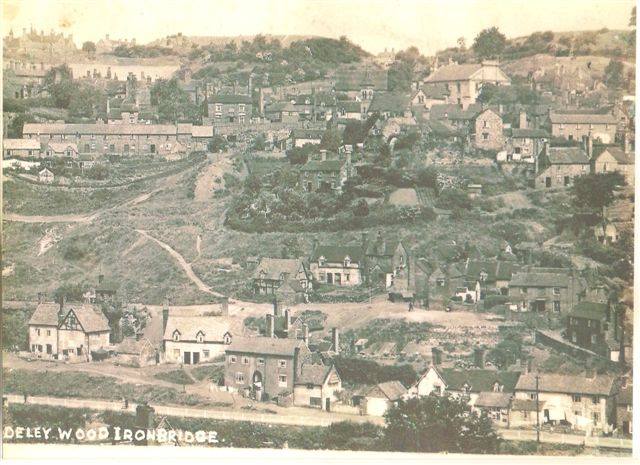
This wide early 1900s panorama sweeps across Madeley Wood, taking in the Bird in Hand bank to the right, the Blockhouse pub in the foreground and Beeches Hospital on the skyline. Behind the wall sits a terrace once nicknamed Gawpers, or Gawbeys, opposite the George — a scrap of local slang that has otherwise vanished entirely from memory.
Madeley Wood and the ferry inns
Where the ferry landed, a pub was rarely far away. The Blockhouse, the Bird in Hand and the Dog & Duck all took their trade from the water.
New Bridge Road, with the pubs marked
Early 20th century
A previous owner has carefully annotated this early 20th-century panorama of New Bridge Road, marking out the garage, the Blockhouse pub and the Bird in Hand. Such hand-written labels are small treasures for historians, fixing exact locations that would otherwise be guesswork from the photograph alone.
Annotated archive photograph
The Blockhouse Inn
Late 19th century
James Potts' name is proudly displayed over the door of the Blockhouse Inn in this late Victorian photograph, with landlord, family and regulars all gathered outside for the camera. Group portraits like this, staged specially for a visiting photographer, were often the only occasion an ordinary pub and its community were ever formally recorded.
Archive photograph, photographer unknown
The inn built in 1774
Late 19th century
A crowd of adults and children pose proudly outside this brick riverside inn in a late Victorian photograph, its owner having dated the building itself to 1774. The gathering suggests the inn was as much a community hub as a business, its river-facing position placing it right alongside the crossing trade below.
Archive photograph, photographer unknown
Ferrymen below the Bird in Hand
Late 19th century
Ferrymen sit aboard their boat in this late Victorian photograph, with the buildings of the Bird in Hand bank rising directly behind them. The inn's name and the ferry's route were intertwined in daily life here, each depending on the passing trade that the river crossing brought to its door.
Archive photograph, photographer unknown
Ferry boat before the timber-framed cottages
Late 19th century
A ferry boat waits at the bank in front of a row of timber-framed cottages in this late Victorian photograph — a building style now almost entirely lost from the Gorge. Fire, flood and redevelopment claimed most such cottages long ago, making this quiet, workaday image an unexpectedly rare architectural record.
Archive photograph, photographer unknown
The ferry and the great tree
Early 1900s
A ferry boat crosses mid-stream in this wide early 1900s river view, framed on the near bank by a single large, spreading tree. Such trees often marked informal landing points along the Severn, serving as landmarks for ferrymen and passengers alike long before any signage existed.
Archive photograph, photographer unknown
Ferry at the riverbank
Early 1900s
Though grainy, this early 1900s photograph is a valuable record of a ferry boat moored at the bank, with cottages stacked up the slope behind it. The steepness of the terrain here explains why so many Gorge communities relied on the river, rather than the road, to move between neighbourhoods.
Archive photograph, photographer unknown
The Dog & Duck
Late 19th century
Two figures sit outside the timber-framed Dog & Duck in this late Victorian photograph, the pub's trade drawn directly from the ferry landing just below it. Riverside inns like this one depended almost entirely on passing ferry passengers for custom, a relationship the pub's very position on the bank makes obvious.
Archive photograph, photographer unknown
Jackfield, Tuckies and the Free Bridge
The 1909 Free Bridge ended the Ironbridge-to-Jackfield crossing. One photograph catches the last ferries still working beneath the finished span.
Crossing from Ironbridge to Jackfield
Before 1909
Photographed sometime before 1909, this scene shows the crossing from Ironbridge to Jackfield, with the gas works visible in the background — later a defining Jackfield landmark. This particular crossing would soon be made redundant by the construction of the Free Bridge, ending centuries of ferry use at this exact spot.
Archive photograph, photographer unknown
The last run of the ferries
1909
The newly completed bridge at Jackfield stands finished in this 1909 photograph, while the last of the old ferry boats is circled on the water below it, almost as an afterthought. It marks, quite precisely, the moment a centuries-old river trade came to an end, replaced overnight by fixed iron and stone.
Annotated archive photograph
The ferry at Tuckies
Late 19th century
A ferry boat sits at the Tuckies bank in this late Victorian photograph, timber buildings crowding the steep slope behind it. Tuckies was a working riverside community in its own right, and its cramped, informal layout of homes and workshops shows just how tightly life here clustered around the water's edge.
Archive photograph, photographer unknown
Tuckies, with the Duke of Wellington and the Boat Inn
Early 20th century
Careful annotations on this early 20th-century photograph identify the Duke of Wellington and the Boat Inn, two pubs that between them served ferry passengers, tileworks labourers and towpath travellers passing through Tuckies. Having two competing pubs so close together says much about how much foot traffic this small crossing point once carried.
Annotated archive photograph
Coalport and the passage boat
The busiest of the lower crossings, and the site of the 1799 disaster. 'Passage boat' was the older, formal name for the ferry.
The Passage Boat, Coalport
Early 1900s
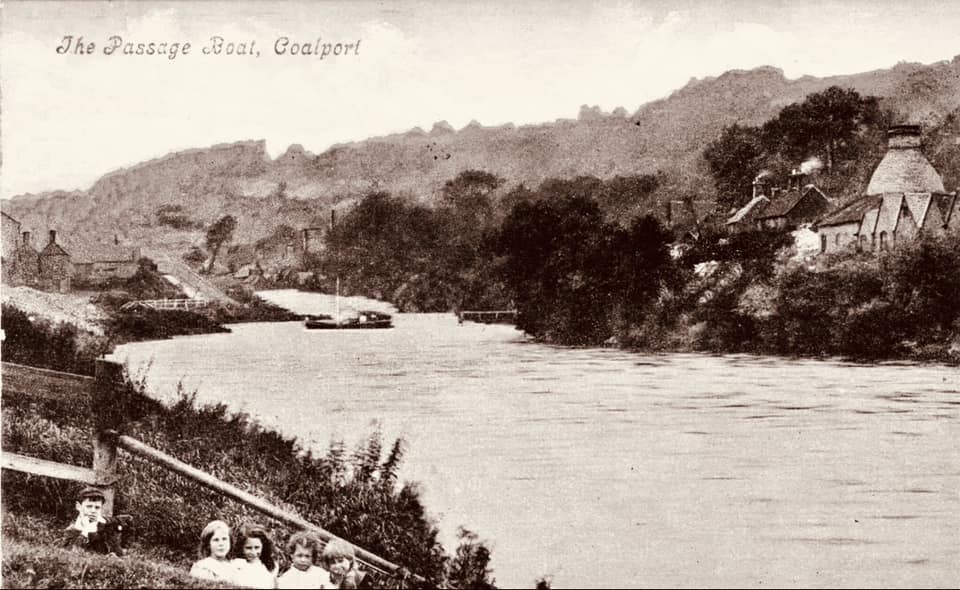
Children pose in the foreground of this early 1900s postcard, formally titled 'The Passage Boat, Coalport'. 'Passage boat' was in fact the older, more formal term for what most Gorge residents simply called the ferry, a small linguistic clue to just how long this crossing had been in continuous use.
Published postcard
The Dog & Duck, colourised
Early 1900s
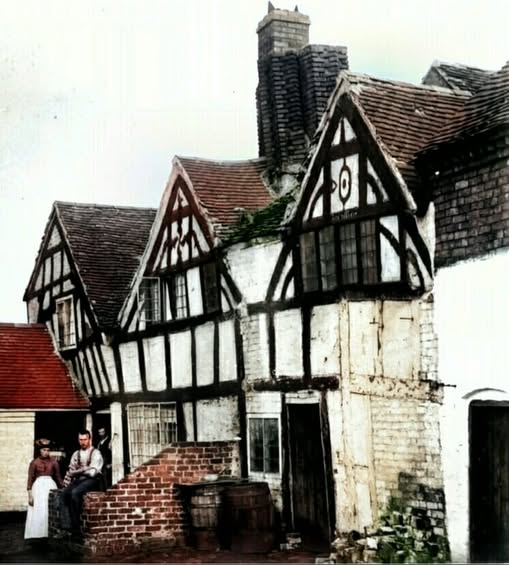
This colourised early 1900s postcard shows the black-and-white timbered Dog & Duck inn beside the river at Coalport, figures visible standing in its doorway. The tinting picks out the timber framing especially well, a detail that's harder to appreciate in the plainer monochrome versions of the same view.
Colourised postcard
The Coalport ferryman
Early 1900s
The Coalport ferryman stands steady at his work aboard the passage boat in this early 1900s photograph. Balancing on a moving boat while managing oars, ropes and passengers took real skill, a quietly physical job that rarely earned its practitioners more than a passing mention in the local record.
Sepia photograph, photographer unknown
A Coalport ferry boat
Early 1900s
Men and children sit aboard the ferry at the Coalport bank in this early 1900s photograph, with benches still visible and room left for more passengers to board. The unhurried mood suggests a quiet moment between crossings, rather than the crush of a typical shift-change rush.
Colourised archive photograph
Men, children and a dog aboard the ferry
Early 1900s
A crowded early 1900s crossing at Coalport includes, among the men and children, a dog that appears to have travelled entirely for free. Small details like this hint at how relaxed and informal the ferries could be, functioning less like public transport and more like a shared neighbourhood errand.
Archive photograph, photographer unknown
A crowded crossing, colourised
Early 1900s
The brick cottages of Coalport rise behind a ferry boat that looks to be carrying a full shift of workers home in this colourised early 1900s photograph. Scenes like this were once utterly ordinary, repeated twice daily as tileworks and mine shifts changed on opposite banks of the river.
Colourised archive photograph
The Coalport ferry, 1911
1911
Firmly dated to 1911, this colourised postcard of a crowded Coalport ferry is one of the few images in the entire collection with an exact year attached to it. That certainty makes it a valuable anchor point for historians trying to date the many similar, undated ferry photographs around it.
Colourised postcard, dated 1911
The 1799 Coalport ferry disaster
Modern graphic, historic photograph
A modern 'Did you know?' community history panel recalls the 1799 Coalport ferry disaster, illustrated here with a historic photograph of the ferry taken near the site of the later Memorial Footbridge. The pairing of old image and new text shows how local memory of a tragedy was kept alive across two centuries.
Community history graphic
A small boat on the Severn
Early 1900s
A single small boat drifts along a quiet stretch of the Severn in this early 1900s photograph, capturing the river not mid-crossing but simply going about its everyday business. Images like this, without ferrymen or passengers in view, remind us the river had a life of its own between the busy crossing points.
Sepia photograph, photographer unknown
The bridges and the river below them
Fords, trows and rowing boats went on using the water long after the first iron arches went up over it.
The ford at Ironbridge
Undated
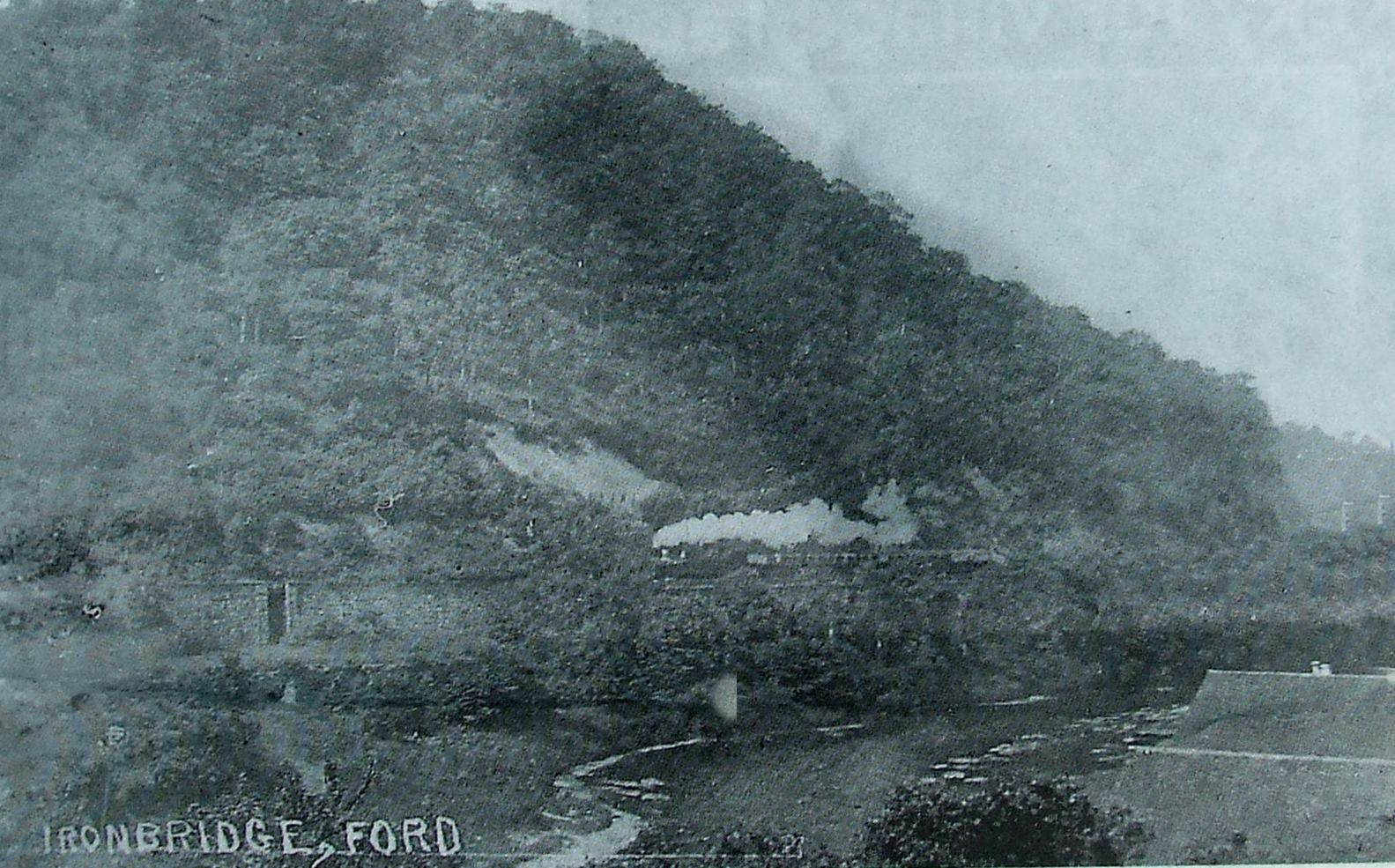
Captioned simply 'Ironbridge, Ford', this grainy, exact date unknown photograph records a crossing point used long before the ferries were formally established and well before the famous bridge was built. At low water, travellers and their goods simply waded or drove carts straight across the riverbed — the oldest and cheapest crossing method of all.
Archive photograph, photographer unknown
The ford, with the railway arches beyond
Early 1900s
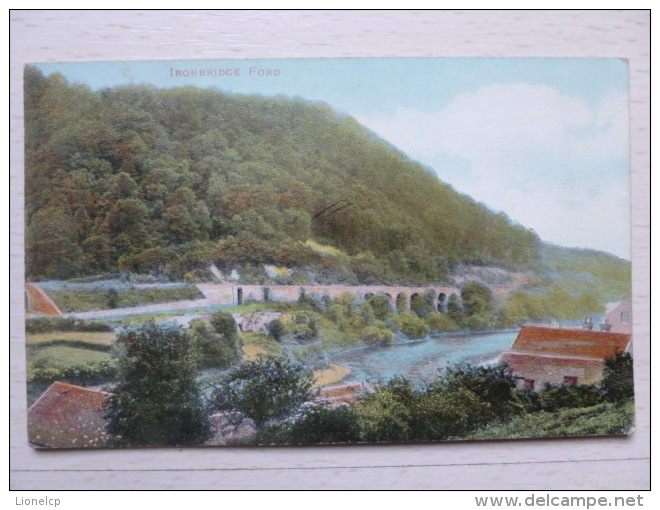
The same ancient ford appears here in colour, photographed in the early 1900s, with the railway arches striding along the far bank behind it. The arches are a useful reminder that fords, ferries and railways all coexisted in the Gorge for decades, each serving a slightly different kind of traveller.
Colourised postcard
Rowing boats below the Iron Bridge
Early 1900s
Pleasure boats are drawn up on the shingle beneath the world-famous Iron Bridge in this sepia postcard from the early 1900s. Even decades after the bridge opened in 1781, the riverbank beneath it remained working ground for boatmen and traders, a detail easily missed beneath the more famous structure looming above.
Sepia postcard
A trow moored at Ironbridge
Late 19th century
A Severn trow — the broad, flat-bottomed sailing barge that carried the river trade — lies moored close to the Iron Bridge in this late Victorian photograph. Long before tourists came to admire the bridge itself, the Severn below it was a genuine working highway, carrying coal, iron and pottery to markets far beyond the Gorge.
Archive photograph, photographer unknown
The Wharfage and the Iron Bridge
Late 19th century
Looking along the Wharfage toward the Iron Bridge in this late Victorian view, a barge sits moored hard against the wharf wall, where goods were once loaded straight from the riverside warehouses. It's a scene of unglamorous, everyday commerce, taking place in full view of what would become one of Britain's most photographed landmarks.
Archive photograph, photographer unknown
The Wharfage, colourised
Late 19th century
This colourised version of the riverfront, taken in the late 19th century, shows the Tontine Hotel and the Iron Bridge closing off the far end of the street. The tinting brings out details easy to miss in black and white, including the muted brickwork that still lines the Wharfage largely unchanged today.
Colourised archive photograph
Albert Edward Bridge
About 1910
This colourised postcard from around 1910 frames the Albert Edward railway bridge, opened in 1864, with an old-fashioned rowing boat drifting on the water beneath it. The juxtaposition wasn't accidental for the photographer: it captures, in a single image, the old world of the ferry crossing being quietly overtaken by iron, steam and the railway age.
Colourised postcard
Cottages below the Albert Edward Bridge
About 1910
Riverside cottages at Coalbrookdale huddle in the shadow of the Albert Edward railway bridge in this colourised postcard from around 1910. These modest homes have since been demolished, and this image is now one of the few visual records of a community that once lived and worked in the very shadow of Coalbrookdale's great ironworks.
Colourised postcard
The Meadow Ferry
Early 1900s
A crowded Meadow Ferry boat sits so still in this early 1900s photograph that its passengers are mirrored almost perfectly in the water below. Boats of this type routinely carried a dozen or more people at once, packed shoulder to shoulder for the short but essential crossing that shaved miles off the walk between riverbank communities.
Archive photograph, photographer unknown
Compare
Several views survive in both original and hand-colourised form. Drag to compare the same photograph as it was printed and as it was tinted for the postcard trade.
Original documents
Zoom the scans, or read the transcription alongside. Search within any document to find a name or a phrase.
agreement · April 1890
Joseph Crowell's ferry agreement
A handwritten agreement concerning the lease of the Coalport ferry boat. The ferries were private undertakings, leased year by year, and the ferryman carried the risk himself.
Manuscript, private collection
newspaper · Shropshire Star, 8 November 2001
Memories of the old ferry
Readers' recollections of the Benthall Edge ferry, gathered by the Shropshire Star. The single richest source of oral history for the crossing.
Shropshire Star, 8 November 2001
newspaper · Shropshire Star, 18 April 2002
Throwing light on grand old hall
A feature on the Grand Hall which incidentally dates the Benthall Edge ferry as still working in 1929.
Shropshire Star, 18 April 2002
newspaper · Shropshire Star, 18 July 2003
Peace and tranquillity on river at Buildwas
A river feature at Buildwas, showing a rowing boat hired from Mr Beddoes — the same family name as the Benthall Edge ferryman.
Shropshire Star, 18 July 2003
map · February 2010
Fords and ferries of the Severn Gorge
A schematic map plotting the recorded fords and ferries against the bridges, from Buildwas to Apley Park. It is the base for the archive's river map.
Broseley Local History Society newsletter, February 2010
Two thousand years of crossing the river
Roman
Fording the Severn
The Gorge is crossed at low water. There is no bridge anywhere between Buildwas and Bridgnorth, and the river runs shallow enough to walk only in summer.
Medieval
Abbey crossings and fish weirs
Buildwas Abbey controls a crossing at the head of the Gorge. Weirs, fisheries and rights of passage begin to appear in the manorial record.
1600s
The passage boats
As the river trade grows, formal 'passage boats' are licensed at Coalport, Madeley Wood and Benthall — rowed or hauled, and leased out year by year.
1779
The Iron Bridge is cast
Abraham Darby III's bridge is erected across the Gorge, opening to traffic on New Year's Day 1781 — the first cast-iron arch bridge in the world.
Read the article →1796
Buildwas Bridge
Telford spans the river at Buildwas in cast iron, replacing the ancient crossing at the top of the Gorge.
1799
The Coalport ferry disaster
An overloaded passage boat goes down at Coalport with heavy loss of life — the event that shadowed every later argument for a bridge here.
Read the article →1818
Coalport Bridge in iron
The wooden bridge at Coalport is rebuilt in cast iron, with toll houses at both approaches.
Read the article →1864
The Albert Edward Bridge
The railway crosses the Severn on a cast-iron arch built at Coalbrookdale — industry crossing the river it had grown beside.
1890
Joseph Crowell takes the ferry lease
A handwritten agreement sets out the terms on which the Coalport ferry boat is worked — one of the few such documents to survive.
Read the article →1909
The Free Bridge and the last ferries
The toll-free bridge opens between Ironbridge and Jackfield. Photographs taken that year show the last ferry boats still on the water beneath it.
Read the article →1922
The Memorial Footbridge
Coalport and Jackfield build a footbridge as a war memorial, ending the passage boat that had crossed here for centuries.
Read the article →1950
The Iron Bridge tolls end
After 169 years, tolls stop being collected at the toll house. The bridge closes to vehicles in 1934 and to everything but foot traffic thereafter.
Read the article →1993
The Free Bridge replaced
The 1909 Free Bridge is demolished and replaced by the present Jackfield bridge.
Read the article →Today
What survives
Landing steps, a corrugated-iron ferry shed, worn stone at the water's edge, and five bridges. Everything else is photographs.
Read the article →
Sources & acknowledgements
- Broseley Local History Society newsletter, February 2010 — fords and ferries map.
- Shropshire Star, 8 November 2001 — “Memories of the old ferry”, readers' recollections of George Beddoes and the wire-rope crossing.
- Shropshire Star, 18 April 2002 — “Throwing light on grand old hall”, with a 1929 ferry reference.
- Shropshire Star, 18 July 2003 — “Peace and tranquillity on river at Buildwas”.
- Joseph Crowell's ferry agreement, April 1890, private collection.
- Postcards and photographs contributed by local families; photographers unknown unless stated.
Can you identify a face, a building or a date in any of these photographs? Corrections and additions are always welcome — they are how the archive gets better.
Explore the river map →Elsewhere in the archive
Stay in the loop
More stories from the Gorge, straight to your inbox
A short weekly email with new history features, archive photographs and what's on across the Gorge.