Pubs of Madeley Parish
Pubs of Madeley Parish
Introduction
A pub in the old parish of Madeley was never simply somewhere to drink. It was where wages were paid out and clubs collected their subscriptions; where inquests were held and coffins rested overnight; where friendly societies met, unions argued, bands rehearsed and courting couples were first seen together in public. Children were sent to the door with a jug; widows were buried out of burial-club money counted on the bar; and when the pits killed men — as they did — it was in the parlour of a pub that the parish first faced the loss.
That is why twenty-six of them could crowd into a few square miles of hillside. The 1849 Tithe Award lists at least twenty-six inns and beerhouses packed into the steep lanes, riverbanks and industrial rows of Ironbridge, Coalbrookdale, Jackfield and Coalport. A few were grand coaching houses built for visitors; most were riverside alehouses barely bigger than a cottage, or front-room beer shops where a miner could get a pint without taking his boots off.
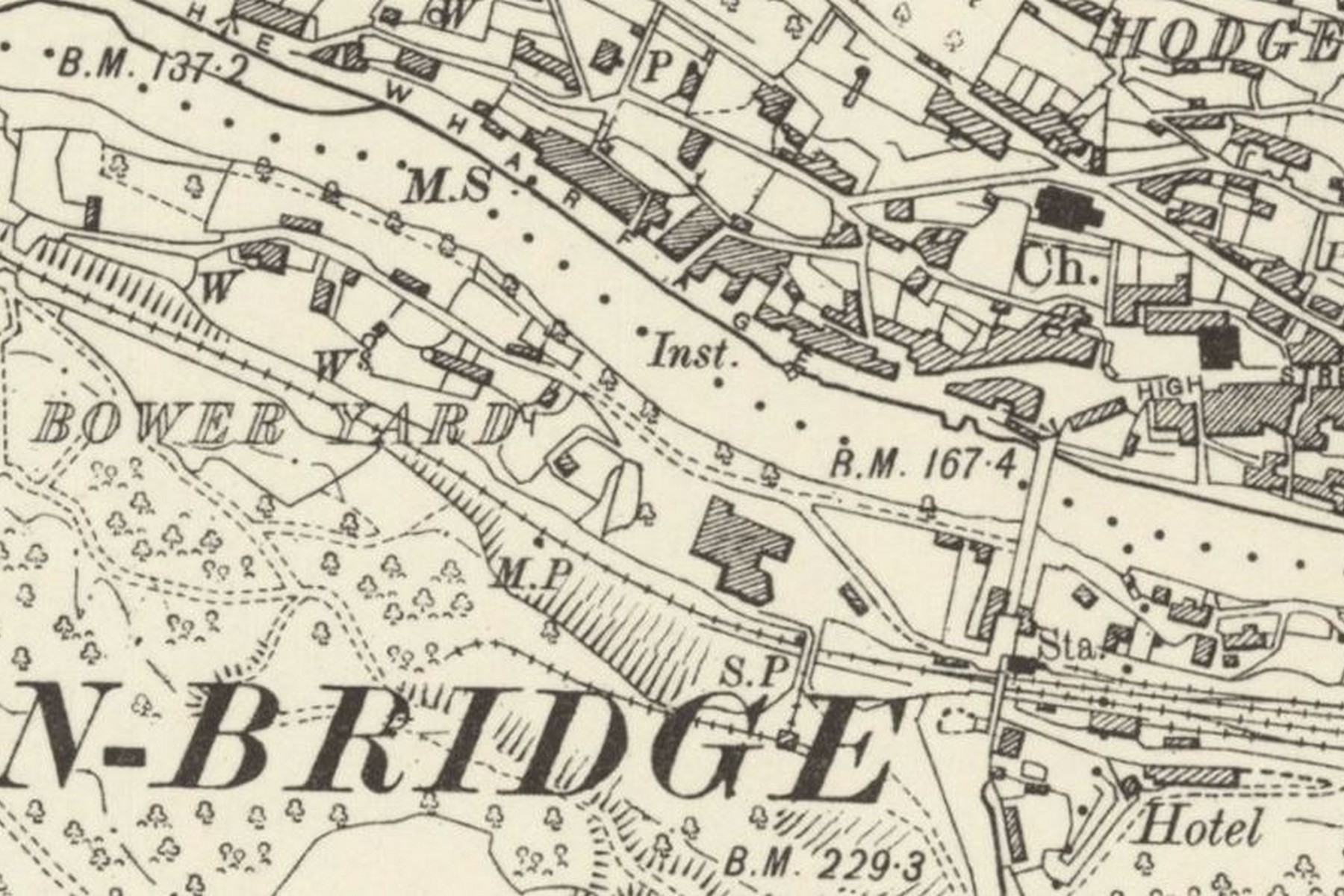
Most have vanished. A handful still trade. What follows is a walk rather than a list — from the pit rows of Madeley Wood, down to the Wharfage and the Iron Bridge, up the lost streets of Waterloo and Hodge Bower, across the river to Jackfield and Coalport, and finally into the old village of Madeley itself. Every date, landlord, demolition and legend recorded here belongs to the places we pass.
The 26 Original Pubs
Setting Out: Madeley Wood and the Coalport Road
We begin where the parish worked hardest — on the pit-and-brickyard slopes of Madeley Wood, where the road runs down towards Coalport and the alehouses were built for men coming off shift.
All Nations Inn — Off Coalport Road, Madeley (1789–present)
No other pub in the country is known to share its name. That alone would make the All Nations remarkable; that it opened in 1789 and has never stopped trading makes it something close to a miracle. While every other inn in the district settled for a Crown, a Royal Oak or a Swan, this little house off Coalport Road took its title from the men at the bar.
The pits, brickyards and ironworks of Madeley Wood pulled in labour from across Britain and beyond, and locals said the district was full of workers from “all nations”. The nickname stuck fast enough to be painted on the sign.
“All nations” — what the district called its own workforce, and what the pub has called itself ever since.
Continuity did the rest. The Baguley family held the licence for an extraordinary 103 years and began brewing on the premises in 1832, making this one of the parish’s earliest home-brew houses. They were builders as well as publicans, credited with constructing several local railway stations — an odd double trade that somehow suits the place.
Slum clearance, licensing cuts and road schemes accounted for dozens of Madeley beerhouses. The All Nations slipped through all of it, and remains one of the oldest continuously licensed pubs in the parish: still open, still brewing, still exactly where it always was.
The Pheasant — Coalport Road, Madeley Wood (mid-19thC–mid-20thC, now a private house)
A few doors uphill, the Pheasant is remembered less for its beer than for the green wooden cabin beside it.
That cabin-shop was run first by Mrs Lloyd and later by Mrs Harris, selling bacon, groceries and clothing — much of it “on tick”. Even Mrs Heighway from the All Nations bought her brewing sugar there. The business eventually outgrew the hut and moved into the shop beneath the Royal Oak in Madeley High Street.
The pub itself was small and unpretentious, drawing its trade from miners, brickyard men and the families strung along this busy route between Madeley Wood and Coalport. It never aspired to be a grand inn, and never needed to be; it was simply the house everyone used, for decades.
Closure came in the late 20th century. Unusually for this stretch of road, the building was spared: it stands today as a private house, one of the few Madeley Wood beerhouses whose fabric still exists.
Down to the Water: The Wharfage and Tontine Hill
From the Wood the lanes drop steeply to the river. Along the Wharfage, the trade changed — boatmen, wharf hands and, from 1780 onwards, sightseers who had come a long way to look at a bridge.
The Rodney — 33 The Wharfage, Ironbridge (early 19thC–20thC)
Patriotism named this one. Admiral Sir George Brydges Rodney (1718–1792) was a national hero when the pub first appears in the records at 33 The Wharfage in the early 1800s, and half the country was naming inns after him. Boatmen and foundry workers drank here first; tourists drawn to the Gorge followed.
Three storeys tall, with a function room upstairs used as a clubroom and dance hall, the Rodney was a landmark on the riverfront. In the 20th century it became flats — Rodney Flats, as everyone called them in the 1960s and 70s. Residents still describe the steep brick steps down to the road and the dark limewashed frontage, long before cleaning revealed the lettering visible today.
Decades after its last pint, the building is Grade II listed and stands as one of the most important surviving former inns on the Wharfage — and as the marker for the long run of riverside pubs that begins here.
The White Hart — 10 The Wharfage, Ironbridge (18thC–present, Grade II listed)
Its sign is older than almost anything else in the Gorge. The white hart — a stag with a crown about its neck — was the personal emblem of Richard II (1377–1399), and to hang it above a door was to advertise stability, tradition and royal protection. Ironbridge’s White Hart therefore belongs to a lineage of medieval-inspired taverns, even though its own records begin in the 18th century.
The river frontage still marks the spot where boatmen, ironworkers and early travellers broke their journeys, and the building carries Grade II listing for its architectural and historic interest.
Where its neighbours fell to 20th-century clearance and redevelopment, the White Hart came through and was later restored with some sympathy. Now trading as a pub with rooms, it offers the clearest surviving impression of what this riverside once looked like when every second door was licensed.
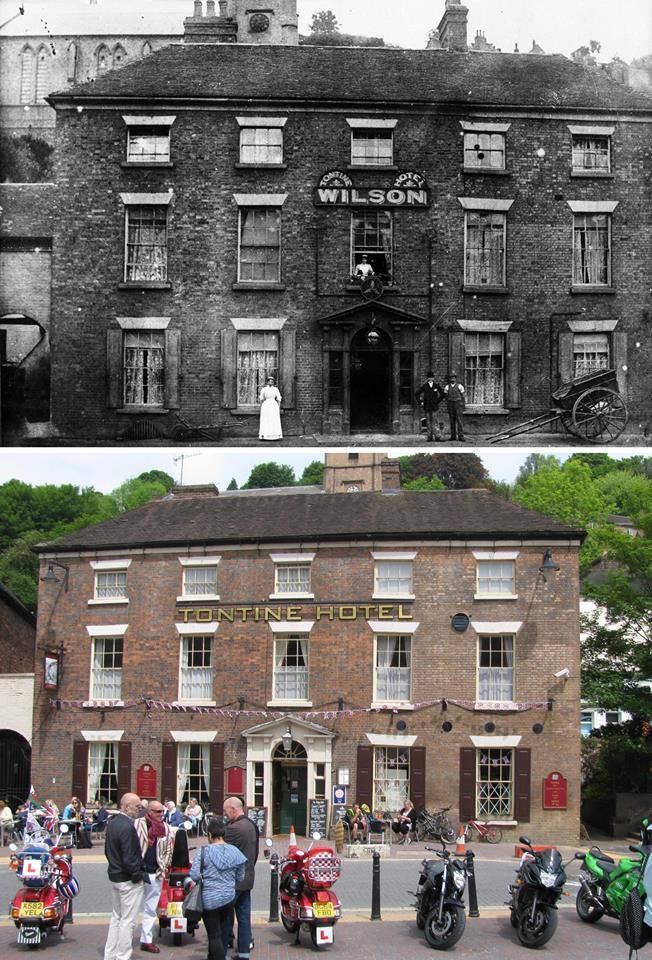
The Tontine Hotel — 13 Tontine Hill, Ironbridge (1780–present, Grade II listed)
The Gorge invented industrial tourism, and the Tontine was built to house it. Raised in 1780 to a design by the Shrewsbury architect John Hiram Haycock, it went up for one reason: crowds were arriving to see the brand-new Iron Bridge, the wonder of the industrial world, and they needed beds.
It became far more than a hotel. The Shropshire Canal Company met here, industrialists gathered here, and travellers treated it as the grand coaching inn of the district. Its symmetrical brick façade and three-storey Georgian proportions remain a textbook example of late-18th-century design.
Even the name is a financial curiosity. A tontine was a subscription scheme in which investors paid in, and the survivors gained larger shares as others died or withdrew; the fund here was never completed, but the label stayed. In 1786 Samuel Wright of Kidderminster extended the building, adding to its bulk and prominence, and its position directly facing the bridge made it the landmark of the Gorge long before tourism had a name.
Darker episodes belong to it too. In the 1950s Frank Griffin — the last man hanged in Shropshire — was arrested at the Tontine after murdering Jane Edge, landlady of the Queen’s Head at Ketley.
Ghost stories cling to Room 5 and the cellar, but the real distinction is endurance. Nearly 250 years on, the hotel still faces the bridge it was built to serve.
The Chestnuts — The Wharfage, Ironbridge
Two trees named this pub, and photographs of the Wharfage still show them standing in front of the building, facing the Severn. First recorded in the 19th century, closed before the 1930s and demolished in 1948, the Chestnuts is now nothing but those photographs.
Inside, it was a modest alehouse for boatmen and Wharfage families — and it gave up the licensed trade early. By the 1920s and 30s the premises had become Hewitt’s Hovis shop, a bakery remembered for its frontage and for an oddity of construction: because of the steep bank behind, the shop floor sat on the second storey at the rear.
The Council condemned the building in 1937 and Hewitt’s moved that same year to 6 Tontine Hill. Demolition followed in 1948, one of many Wharfage clearances. The trees outlived the walls; then they went too.
Uphill: The High Street
A short climb from the river brings us to the High Street, where the pubs took in commercial travellers rather than boatmen — and where the hillside itself would later decide which buildings survived.
Three Tuns — 31 High Street, Ironbridge (1812–mid 20thC)
Few Ironbridge pubs have closed so completely and yet changed so little: licensed by 1812, out of the trade by the mid-20th century, and still, ninety years on, a shop below and lodgings above.
Lodgings were the business here. Long established by 1812, the Three Tuns took in the constant traffic arriving from Madeley, Coalbrookdale and the Gorge, and traded through the Victorian era as a “Commercial Hotel”. The name refers to the great wooden tuns used in brewing, a sign found on high streets across the country.
One surviving photograph captures the proprietor, John Davis, posed in his doorway beneath advertisements for rooms, food and stabling.
Trading ceased in the mid-20th century, but the building came through untouched. The ground floor has stayed in public use — remembered as Nettie’s, then a traditional sweet shop, more recently a pop-up gallery — while the Georgian frontage above remains among the best preserved on the street. John Davis would still recognise his doorway.
Queen’s Head — foot of Madeley Bank, Ironbridge (1829–early 20thC, demolished)
Nothing of it survives above ground, but for the best part of a century the Queen’s Head stood at the foot of Madeley Bank, on the left-hand side — licensed by 1829, closed in the early 1900s, and pulled down when the hillside itself turned against the street.
Harriet Fowler is the first licensee on record, in Pigot’s Directory of 1829. Later landlords included Joseph Fletcher and Edmund Joseph Ryalls, who kept his connection with the pub until his death in 1931.
The house also had its Queen’s Head Vaults, a separate drinking room further along the High Street. That building still stands — it is now the Elephant Crossing.
During the First World War the rooms were given over to convalescing soldiers, one of several Ironbridge inns turned to wartime use. Its beer came from the Severn Brewery of Edwin Fletcher Groves, who supplied houses across Ironbridge, Madeley and Broseley in the late Victorian years.
Architecturally its signature was a perron — a walled staircase that stopped drinkers stepping straight into the traffic, of the type still to be seen outside the Coalbrookdale Inn.
The hillside finished it. When the Queen’s Head was demolished, the cottages and shops beside it came down too, and the land slipped. Mid-20th-century clearance and stabilisation works followed, and local memory is consistent that it came down in the same period as the collapse of Gainham’s shop further up the bank. In Ironbridge, the ground has always had the last word.
Coopers Arms — Severnside, Ironbridge (c.1840–1938/39, demolished)
Demolition usually means disappearance. The Coopers Arms is the exception: its bricks are still standing, in the shape of a house called Victory.
The pub occupied a patch of riverside at Severnside long known as Gareys (or Gearys) Square, and both it and the cottages behind belonged to the Owen family.
John Owen came here with his wife and family after retiring from working barges on the Severn. Before him the property housed Tommy Rogers the poacher, who lived there until his death in 1924; it had originally been inhabited by his wife’s uncle, with whom they lodged.
A photograph of about 1890 shows the pub in its working prime, before the decline set in. It lasted into the early 20th century and was pulled down in 1938–39 in the slum clearance that remade Severnside.
The Owens kept the land and cottages to the very end. Rather than submit to compulsory purchase, the family sold within itself — to Harry Rogers, whose wife Christiana was a granddaughter of John Owen. Harry and Christiana had taken on the pub after returning from Wrexham, handed it by Harry Owen of Everall Grove on Bath Tavern.
Then came the rebuilding. Harry Rogers worked with Sam Moseley — Christiana’s brother-in-law, who drew up the plans — using salvaged brick and timber from the Coopers Arms and its cottages to raise the house they named Victory, living in the cottages while the work went on. The house is a direct continuation of the pub, made physically from its remains.
Above ground, nothing of the original survives. The story does — in the Owen family, in the reused fabric of Victory, and in that single photograph from the 1890s.
A Street That No Longer Exists: Waterloo Street
Turn the corner from the Wharfage and you enter the part of this walk that can only be taken on paper. Waterloo Street was once one of the busiest rows in the town, with four pubs within a few hundred yards. Two of them are now roundabout.
Blockhouse — Waterloo Street, Ironbridge (1829–early 1970s, demolished)
Stand on the traffic island at the bottom of Madeley Road and you are standing in the bar. Pigot’s Directory listed the house in 1829 under landlord John Till; it stopped serving in the mid-20th century and was swept away in the early 1970s for roadworks and landslip stabilisation. The Blockhouse belonged to the row that also held the Crown Inn, Woolley’s shop and Beddoes’ warehouse, and Pigot’s Directory of 1829 already lists it — as “Block House Rock”, under landlord John Till.
Through the 19th century it drew on the households immediately around it, when Waterloo Street was a dense mix of homes, workshops and small businesses. By the 1960s the whole street was failing: subsidence, dereliction and road-safety problems had made its future hopeless.
Telford Development Corporation’s road realignments and landslip works of the early 1970s finished the job. The Blockhouse went, the Crown went, and most of Waterloo Street went with them, cleared for the new junction layout.
Photographs preserve what the maps cannot: a plain two-storey frontage set tight to the pavement — an entire street erased inside a single decade.
Bird in Hand — Waterloo Street, Ironbridge
Thirty-three years behind one bar is a rare thing anywhere; at the Bird in Hand it was the making of the pub’s reputation. Known by that name from 1871 — and, by local tradition, as The Lamb and then The Hat & Lamb before it — the house served Waterloo Street until 2020 and is a private home today.
The first firm record is the 1871 census, which lists the Bird in Hand Inn with Edward Jones, fitter, as landlord. Before that, tradition remembers it as The Lamb and then The Hat & Lamb, names linked to the Shingler family of hat-makers; beneath the building are cellars of a design said to resemble those at Buildwas Abbey.
Known Landlords & Trades
- 1871 — Edward Jones, fitter, landlord when first recorded as Bird in Hand
- 1891 — John Bate, iron moulder, publican
- 1901 — Thomas Henry Jones, brickworks labourer, publican
- 1911 — John Beddow, tile presser, publican
- Late 20th century — Bill, Hazel & Steve, landlords for 33 years, the longest-serving in Ironbridge
Read that list again and the pub’s character is obvious: a fitter, a moulder, a brickworks labourer, a tile presser. These were working men keeping a bar as a second trade, on a street of small workshops, cottages, corner shops and lodgings for boatmen and ironworkers.
Nothing about it was grand. It was a street pub — somewhere to call in after a shift or meet a neighbour for a quiet pint — one of a short run that also included the Crown, the Blockhouse and the Robin Hood.
Then came the long era of Bill, Hazel and Steve, whose 33 years made them the longest-serving landlords in Ironbridge. Regulars remember the cosy front bar, the hillside beer garden, the charity nights and parties, and Bill’s wall of framed photographs of the Iron Bridge, taken by the very talented local photographer Graham Hickman.
The end, around the pandemic, was quiet but deliberate: regulars gathered in the garden with their own drinks so as not to break the rules, refusing to let the place close without a send-off. It is a private house now.
Ye Olde Robin Hood — 33 Waterloo Street (early 19thC–present)
The sign above the door once carried a joke rather than a name.
“Now that Robin Hood is dead, come and drink with Little Ted.”
It belonged to Edwin “Ted” Owen, a famously short landlord of the early 20th century, and it tells you most of what you need to know about the temperament of a pub first recorded in the early 1800s, tied to the Owen brewing family ever since, and still trading today.
It sits near the bottom of Waterloo Street, close to the site of the historic Free Bridge and directly opposite the spot where the Dog & Duck once stood on the Jackfield bank — a pairing of pubs across the water that lasted for generations.
Ted belonged to a dynasty. His sister Hannah Owen ran the Railway Tavern; their father George Owen kept the Foresters Arms; their ancestors held the Coopers Arms at Severnside; and their great-niece Emmie Goodwin later ran the Horse & Jockey. Trace the Owens and you have traced half the licensed trade of Ironbridge and Jackfield.
Of the Waterloo Street pubs, only this one came through the demolitions, landslips and redevelopment. It still trades, in its original building, still unmistakably a local.
Across the Water: Jackfield
Opposite Waterloo Street the river bank belonged to the tile and pottery villages. Jackfield alone once had twelve pubs; the three that follow tell the story of the ferry, the works and the flood.
Dog & Duck — Jackfield (1654–c.1940, demolished)
Before there was a bridge here, there was a boat — and beside the boat, an inn. Built in 1654 for Adam and Margaret Crumpton, the Dog & Duck was a long, low, timber-framed range standing directly on the water’s edge, facing Ironbridge across the Severn.
Beneath the bedroom windows the builders cut an inscription — Crumpton, Adam and Margaret, and the day they finished.
“C.A.M. May 30 1654”
The Crumptons were ferrymen by the 1680s, and the pub stood a few yards from the Jackfield–Coalport crossing. Its customers were the river itself: boatmen, clay workers, potters walking up from Coalport, and anyone waiting for the ferry in the long centuries before a bridge existed at this point.
That grip on the trade lasted. In 1851, close to the Dog & Duck, a William Crumpton is recorded as proprietor of the nearby Ferry Boat Inn.
By the 19th century the licence had passed to Edward and Caroline Williams, who kept it for decades, then to their daughter Dora and her husband Richard Evans until the early 1890s. The building was ancient even then, described as “a long, low range of half-timber dwellings”.
The licence was not renewed in 1892 and the range reverted to cottages, though the pub is recorded as still operating as late as 1939. What finished it was the ground it stood on: the riverbank here was never stable, and demolition came around 1940. Three hundred years of ferry trade ended not with closure but with subsidence.
Black Swan (Dirty Duck) — Lloyds Head, Jackfield (mid-19thC–present)
Ask for the Black Swan in Jackfield and you may get a blank look; ask for the Dirty Duck and you will be pointed straight to it. The pub has stood on the riverside near the old sidings and pottery works since the mid-19th century, and trades still — under one name on the board and another in the village.
The sign has only ever read The Black Swan. It has been a Jackfield fixture since the mid-19th century, drawing on the tilemakers, boatmen and railwaymen who lived and worked along this stretch of riverside near the old sidings and pottery works.
The nickname has no documented origin, only competing explanations. Some blame the coal dust and river mud that once coated everything in Jackfield; some say boatmen joked that the swans by the wharf were permanently filthy; others simply remember a pub that was a bit rough round the edges, in the best possible way. Whichever is true, the name belongs to the people rather than the signboard — which is why it has never appeared on it.
Survival is the other headline. The Black Swan outlasted the Dog & Duck, the Duke of Wellington and the Tumbling Sailor, and is now one of very few Jackfield pubs still trading in its original building. Inside there is no pretence: river views, a bar, and a crowd of locals keeping a nickname alive that the sign has never acknowledged.
Half Moon — 174 Salthouse Road, Jackfield (1840–present)
Most pubs treasure a photograph or a tankard. The Half Moon’s relic was a jug the size of a man.
A landlord once challenged the Coalport China Works to make a jug “as big as a man could manage”, promising to fill it with ale if they managed it. They did; he did; the locals drank it dry. When a great flood carried the jug downstream, villagers salvaged the pieces, glued it back together and returned it to the pub. It now lives at the Museum of Iron in Coalbrookdale.
The pub began in 1840, built on the footprint of an earlier coach house serving the old riverside road. In a village that once counted twelve pubs, it was among the most important stopping points for potters, boatmen, railwaymen and anyone moving between Coalport and Ironbridge.
Its early 20th century belongs to the Davies family, who held the licence for thirty-five years. William Davies took over in the early 1900s and stayed until his death in 1938; the well-known 1915 photograph of the pub almost certainly shows his family gathered outside. A second long era followed under Alf and Annie Skitt, who ran the Half Moon until the early 1980s and retired to Coalport just before the road collapse that reshaped Jackfield.
Beside the pub ran “The Mekest”, the straight road along which workers sprinted to reach the factory gates at Maws and Craven Dunnill before the siren stopped.
Five minutes late cost a day’s pay.
Landslips and road realignments have rearranged everything around it, yet the Half Moon has survived and expanded, and trades still — one of the last living links to Jackfield’s industrial riverside.
Upriver to Coalport
Follow the Severn east and the tile works give way to the china works, the canal and the wharves at Coalport, where the beer was made on the premises and rolled straight onto the water.
The Brewery Inn — Coalport High Street (early–mid 19thC–present, Grade II listed)
The clue is in the name and confirmed by the ramp. This was a working 19th-century brewery, and the ramp at the rear existed so that barrels could be rolled down to river barges waiting below. Brewery Gold cask ale is still sold here alongside the proprietary brands.
Today it is a family pub with a riverside summer holiday cottage next door and an enclosed patio terrace looking out over the water. The large car park keeps tie rings, a mounting block and fresh water for horses, and day tickets are available for anglers.
Its Grade II listing came in 1974, and the official description records what the eye half-notices: an early/mid C19 range of cottages in buff brick, tiled roof at various levels, two storeys, fourteen windows, small segmental arched openings with casements and horizontal pivot windows with glazing bars, plank doors, a segmental arched cartway at the centre and brick ridge stacks.
That fabric, dating from around 1830–1850, is the reason the building reads as industrial rather than picturesque: it was made for barrels first and drinkers second, back when Coalport’s river trade was at its height.
Refurbishment has now brought the Brewery Inn back — not as an untouched old tavern but as a riverside pub reopening its doors, keeping the spirit of the old name while stepping into the present. The views are unchanged, the river still slides past a few feet away, and those listed walls carry nearly two centuries of Coalport’s working life.
Back to Madeley Wood and the Hillside Lanes
Climbing away from the river again, the walk returns to the pit district — Madeley Road, Newbridge Road, Jockey Bank and Bath Road — where the pubs were plain, close-packed and tied to the collieries that surrounded them.
George & Dragon — 15 Madeley Road (early 19thC–20thC, building survives as a house)
In 1864 the parish suffered the disaster remembered as the “Nine Men of Madeley”, and it was to this pub that some of the bodies were first brought, before the inquest was moved to the police station on Waterloo Road. No other fact about the George & Dragon matters more locally.
In ordinary times it was simply one of Madeley Wood’s most traditional old inns, appearing in early 19th-century records and listed in Pigot’s 1829 Directory under landlord Matt Thompson. Its sign — Saint George slaying the dragon — was among the most widely recognised in England, and sat well in a district of miners, forgemen and industrial labourers.
Closure came in the late 20th century and the premises became a private home. Grade II listed, its early-19th-century frontage is unchanged: a rare Madeley Wood alehouse still standing, in domestic use.
Golden Ball — 1 Newbridge Road, Ironbridge (licensed 1728–present)
Licensed in 1728, half a century before the Iron Bridge was cast, the Golden Ball has the longest unbroken record of any pub in the Gorge. It stands on Wesley Road — once, memorably, called Thieve Street — and was serving miners, ferrymen and ironworkers when the valley was still better known for coal than for engineering.
Its sign is another medieval inheritance: the golden orb of the silk-mercers, hung outside their shops and later borrowed by innkeepers everywhere. No silk-working tradition ever existed in Ironbridge; the emblem was simply fashionable, and it stuck.
Edward Wallett, one of the “Nine Men of Madeley”, lived close by with his family, and this would have been among the nearest houses of refreshment for the men working the pits and brickyards across the hillside.
The distinction that matters, though, is negative: the Golden Ball has never closed. Not for clearance, not for licensing reform, not for redevelopment. It remains a thriving Grade II listed pub with rooms, full of old brickwork and an age that nothing else in the Gorge can match.
Horse & Jockey — 15 Jockey Bank (19thC–2020)
Collieries, clay pits and workers’ rows surrounded this one, and its clientele came from all three. It appears in 19th-century directories, Pigot’s 1829 list among them, and lasted long enough to become one of the best-remembered Madeley Wood houses.
Mrs Davies kept it in the Victorian period. Later it passed to the Owen/Goodwin family — the same dynasty behind the Robin Hood, the Railway Tavern and the Coopers Arms — and Emmie Goodwin, great-niece of Hannah Owen of the Railway Tavern, became one of its best-known landladies.
The Horse & Jockey closed in 2020, remembered for a tight-knit clientele and its links to the working families of Madeley Wood. When it went, the last of the parish’s “sporting inns” went with it.
The Unicorn — 6 Newbridge Road, Ironbridge (mid-19thC–20thC, private residence)
High on the slope between Bedlam Furnaces and the Coalport Road, the Unicorn was a hillside beerhouse of the plainest sort, serving the men of Bedlam, the Foundry Cottages and the families along Newbridge Road.
Licensing records pin it down: transfers name Frederick Fiddler as landlord and confirm that the pub stood in Ironbridge rather than Jackfield, where it is sometimes mistakenly placed. Period sources also put it close to Shingler’s Bank, named for the Shingler family of hat-makers whose workshop gave the area part of its identity.
Aerial photographs from the 1930s bear the location out, showing the pub roughly opposite No. 52 Newbridge Road — the Rock Chapel — on the stretch where cottages once stepped sharply down the hillside.
Its appearance matched its trade: a plain frontage, tight to the lane, attached to a short row of cottages. It traded well into the early 20th century, then closed and became a private residence.
Bath Tavern — Bath Road, Ironbridge
Not every pub leaves a story, and in a parish of disasters, dynasties and demolitions that is worth noting. The Bath Tavern first appears in 1851, closed quietly during the 20th century, and stands today as a private house.
Its earliest confirmed appearance is the 1851 census, with Frederick Poole listed as publican. It served the small hillside community between Church Hill and the Wharfage: never a large inn, simply a beerhouse for residents and for workers walking between Madeley Bank and the river. Nothing dramatic enters the records, and it probably traded quietly for several decades before closing in the early-to-mid 20th century.
Where so many Ironbridge pubs were pulled down, this one was simply repurposed — and its plain façade still gives it away to anyone who knows what to look for.
The Oak — Church Hill, Ironbridge
Church Hill was thick with houses and thick with children — St Luke’s Road, the Blue School and terraces climbing towards Lincoln Hill — and The Oak, recorded from the early 19th century, sat just above the junction with Madeley Road to serve them until it closed around 1900. It is a private house now.
It appears consistently through 19th-century pub lists and directories, including the parish survey that counted it among Ironbridge’s “well-known inns”. One recorded landlord is Ketley, a surname preserved only in the 19th-century signboard list, which places him in the early–mid Victorian period.
The building escaped demolition altogether — one of the best-preserved former alehouses on the street, hiding in plain sight.
The Crown — 10 Hodge Bower, Ironbridge
Somewhere in the undergrowth above Hodge Bower are the collapsed remains of a Victorian observatory, built by a landlord to persuade drinkers to walk uphill. The pub it belonged to was recorded from the early 19th century, closed in the mid-20th, and is now residential apartments — but its pleasure gardens and telescope are the reason it is remembered.
The pub itself stood partway along Hodge Bower, a Banks’ house in its later years and a well-used locals’ before it closed and was converted into homes. In the early 20th century it was run by Flow and Walter Chubb, whose names stayed over the door for decades; when the Crown finally shut, the original signboard was rescued, repainted and hung at Crown View, where it remains one of the few physical traces of the inn.
The gardens were the work of Thomas B. Martin, landlord in the 1870s, who turned the steep ground opposite into a Victorian viewpoint garden: terraces, walkways, sweeping views over the Gorge and, most unusually, a telescope in a purpose-built observatory. Contemporary Ordnance Survey maps show the structure clearly, perched to overlook the river and the Iron Bridge.
After 1900 the land changed use, becoming a market garden into the 1940s before being sold and absorbed into the private gardens of the Church Hill houses.
The observatory has not quite gone. The Historic Environment Record (PRN 32530) notes the ivy-covered, partially collapsed remains of the little telescope building, its pyramidal roof timbers still detectable from the air (what3words: upstarts.readjust.greet).
Closed pub, lost gardens, ruined observatory: few former inns in the parish are layered quite so deeply.
White Horse — Lincoln Hill (18thC–2018, now closed)
Music, not industry, gave this pub its late fame.
Several locals remember Jake Thackray — the name often mis-spelt as “Thackery” — keeping the White Horse for a time. His brother Richard Thackray was the well-known folk singer and television performer of the 1960s and 70s, and the connection gave the pub character and a strong musical following.
Whether Jake was landlord outright or simply helped run it depends who you ask; on Lincoln Hill nobody doubts it.
Long before that, the pub served the scattered cottages, quarrymen and lime-workers of the wooded slopes between Ironbridge and Madeley, appearing on maps from the early 1800s as a stopping point on the old road down to the Gorge. By the mid-20th century it was in the hands of J. H. Dodd, whose name appears above the door in one of the oldest surviving photographs.
The modern building, whitewashed gable facing the road, stayed a familiar landmark into the 2010s. After centuries of trade the White Horse closed in 2018, the last of the Lincoln Hill pubs to go — though its rearing white horse still gallops across dozens of old photographs.
Journey's End: Madeley Village
The walk finishes where the parish began, in the old village around St Michael’s: an ancient High Street, a churchyard, and the last of the twenty-six.
Three Horse Shoes — High Street, Madeley
The oldest inn sign in the parish hung above a building of rubble, mud and plaster on the top stretch of Madeley High Street.
“One of the oldest in the kingdom.”
So one early account described the sign of the Three Horse Shoes, recorded here from 1749. The pub closed in 1968 and was demolished two years later.
The name draws on the old belief that a horseshoe nailed above a doorway brings luck, a superstition the Three Horse Shoes carried on its board for more than two centuries.
In the 19th century it was kept by J. H. Robinson and served for generations as the community pub of the upper High Street.
Decline set in by the late 1960s, and demolition came in 1970 during the redevelopment around the Anstice. Nothing of the fabric survives. The oldest sign in the parish outlasted two centuries and lost to a car park.
Six Bells — Church Street, Madeley (19thC–present)
Its name was rung, not written. When the pub was established, St Michael’s opposite carried a peal of six bells, and the inn simply took the number for its sign.
The peal did not stay at six. After the First and Second World Wars the parish raised money by public subscription to increase the bells to eight, in memory of local people who had died — but the pub kept the older count, and keeps it still.
Through the 19th and 20th centuries it stayed what it had always been: a community local for the families around Madeley’s old village core. Where so many parish pubs went in slum clearance and redevelopment, the Six Bells modernised instead, and held its place.
Inside today the L-shaped room divides between lounge seating and a bar with darts and sport, with a beer garden to the rear and a large car park.
Its setting is the point: a short walk from Blists Hill Victorian Town, directly opposite the church and graveyard that named it, and one of the very few Madeley pubs still trading where it always stood.
Wheatsheaf — Madeley (early 19thC–early 20thC, demolished)
We end with a pub that is now only paper. The Wheatsheaf appears clearly in Pigot’s Directory of 1829, with Aaron Lloyd as landlord, and then gradually disappears from the record altogether.
It stood somewhere in the old Madeley village core — most probably in the Court Street and Church Street cluster, where a tight row of beerhouses supplied miners, ironworkers and labourers from the surrounding pits and forges.
The sign was a countryside inheritance: a sheaf of wheat, standing for harvest, breadmaking and prosperity, and common in agricultural districts like Madeley before the industrial boom arrived to change what people did for a living.
Nothing in the sources suggests a coaching inn or a substantial house — every indication is of a modest beerhouse selling ale to the families around it.
By the early 20th century it had gone from the licensing records, one of many small Madeley pubs closed under tightening legislation and then swept away in the clearances and road improvements of the 1930s–60s. No part of it survives, and not even its plot can now be pointed to: a pub reduced to a single line in a directory of 1829.
Why the Pubs Still Matter
Set the survivors and the losses side by side and the parish explains itself.
The pubs that lasted are the ones the modern Gorge grew around: the Tontine facing the bridge it was built to serve, the Golden Ball licensed since 1728 and never once dark, the White Hart and the Brewery Inn carrying their listings and their old brickwork, the Black Swan and the Half Moon still holding their stretch of Jackfield riverside, the All Nations still brewing off Coalport Road, the Six Bells still ringing under its church, the Robin Hood the sole survivor of Waterloo Street.
The pubs that went map the same story in reverse. The Chestnuts and the Coopers Arms fell to slum clearance; the Blockhouse and the Crown to landslip and road-building; the Three Horse Shoes to town redevelopment; the Dog & Duck to a riverbank that would not hold; the Wheatsheaf to licensing reform and simple forgetting. Between them they date every upheaval this valley has been through — the river trade, the pits and tileworks, the collapse of both, the clearances, and the arrival of the New Town.
What they shared was function. These were the parish’s meeting rooms and pay offices, its clubrooms, inquest rooms and concert halls, the places where nine dead miners were carried in 1864 and where, more than a century and a half later, the regulars of the Bird in Hand stood in a garden with their own drinks to say goodbye. Museums preserve the industry of the Ironbridge Gorge; the pubs preserved the people who did it.
That is the case for treating the surviving ones as heritage in their own right — not as background to the bridge, but as the last working rooms of an industrial parish, still open, still in use, and still doing the job they were built for.
More Gorge history
Read another story
Elsewhere in the archive
On the river map
Stay in the loop
More stories from the Gorge, straight to your inbox
A short weekly email with new history features, archive photographs and what's on across the Gorge.