Ironbridge
The Talbot Inn to The Malthouse
Centuries of drinking, brewing, fishing, film, food and music on the Wharfage
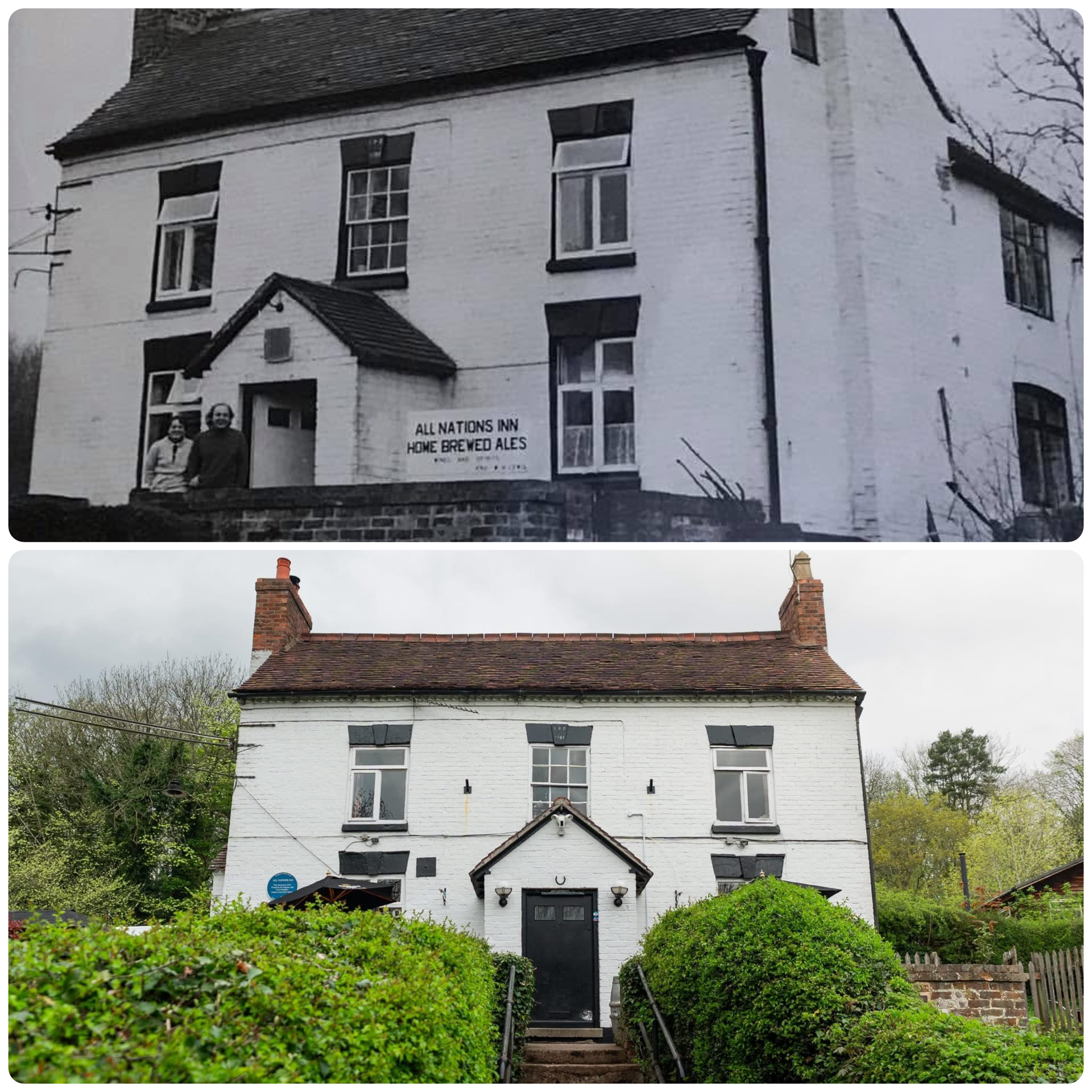
Two photographs, the same wall, and a good many years between them. The building on The Wharfage that everybody now calls The Malthouse was for generations the Talbot Inn, and the painted signwriting on these old prints is the clearest proof of it.
Behind the familiar white frontage is something older still: a sixteenth-century timber frame, later refaced in painted brick. Beside it stands the tall former warehouse with its gabled end and loading doors — very probably the original malthouse, and the reason the modern premises carries the name it does.
An old inn in industrial Ironbridge
The Talbot was already old when Ironbridge became the busiest industrial valley in Britain. The timber frame is sixteenth-century; the brick front came later, in the late eighteenth century, when the riverside was being rebuilt to suit a wharf trade rather than a farming hamlet.
Behind the site, a tunnel was cut into the embankment by Reynolds in 1800 and is still remembered locally. Four years later the Cornish engineer Richard Trevithick, whose high-pressure steam engine was then the talk of the trade, lodged at the Talbot during a visit to Ironbridge.
Telford, Wilkinson and other ironmasters are also said to have gathered here. It is entirely plausible — this was the inn nearest the wharf — but it should be read as local tradition rather than documented fact.
Beer, brewing and the magistrates
Nothing brings an old pub back to life quite like the court reports, and the Talbot supplies two beauties.
The first concerns Ernest Ralphs, a farmer from Buildwas, charged with being drunk on the licensed premises of the Talbot Inn, then kept by Mr Walter Hy. Welch. William Parker, a labourer of Madeley, and Henry Parker, a miner of Madeley, said they had seen him drunk at the "Talbot". P.S. Morris told the bench he had found Ralphs in the back yard in a very drunken condition — he got up, staggered, and fell down.
He got up, staggered, and fell down like a log of wood.
Ralphs, on oath, denied that he was drunk. Several witnesses gave evidence on his behalf, swearing he was not drunk. The case was dismissed.
The landlord was not always so fortunate. Under the headline AN IRONBRIDGE LICENSE ENDORSED, another report records that James Toddington, landlord of the Talbot Inn, was charged with permitting drunkenness. Sergeant Hamlet stated that when he visited the house he saw a man named John Licence sitting at a table in the kitchen with other men, drinking ale, and that he was drunk. The landlord promised it should not occur again. He was fined £1 and 9s costs, and the licence was endorsed.
Beer at the Talbot was not merely sold, it was made. A small advertisement in the situations-vacant columns gives the flavour of the brewhouse better than any description:
YOUTH Wanted, about 18, to assist in brewing, and to make himself generally useful; live in. — Welch, Talbot Inn, Iron-Bridge.
The Talbot as a meeting place
Pubs like the Talbot were not simply places to drink. They were the nearest thing the valley had to public rooms.
A newspaper notice for the Hearts of Oak Benefit Society invited members living in the districts of Ironbridge, Madeley, Coalbrookdale and Broseley to attend a meeting at the Talbot Inn, Wharfage, Ironbridge, on August 31 — for the purpose of appointing a doctor. The honorary secretary was W. Nicholas.
Appointing a doctor was serious business for working families paying weekly into a friendly society. That the whole district met to do it in the front room of a riverside inn says a great deal about what these buildings were for.
Anglers at the Talbot
In 1885 the Talbot saw the founding of the Ironbridge Angling Society, led by Theobald Jordan and William Waghorn.
Competitive fishing became something of a craze on this stretch of the Severn, with beer — or the occasional cash prize — for the biggest catch. By the 1970s more than a thousand anglers regularly fished the river between Bridgnorth and Shrewsbury. The inevitable decline came in the 1980s, but the Society was later revived and thrives again today.
The old group photographs outside the inn belong to this world of outings, societies and club nights, though the individuals in them are not identified in the surviving captions.
When Hollywood came to the Talbot
In 1949 the Talbot courtyard was used during the filming of Mary Webb's melodrama Gone to Earth, starring Jennifer Jones, with local people drafted in as extras.
The film may have flopped, but the memory of Hollywood in Shropshire lingered rather more fondly than the reviews.
Percy and Violet
Through the mid-twentieth century the pub remained a community hub, with a bowling green until relatively recently.
In the early 1960s it was run by Percy and Violet Morris, and later by Thelma Bidgood. Their Christmas greeting, set in a decorated border in the local paper, is the sort of small advertisement that fixed a landlord and landlady in the public mind for a generation — no surnames needed, just Violet and Percy of the Talbot.
The building nearly changes again
By the 1970s the Talbot had been recognised as an important historic part of Ironbridge. Conservationists described it as an "important historical component of the built environment", noting that it had recently been restored as a licensed restaurant and was largely unspoiled externally. It was Grade II listed in 1974.
The same report is blunt about its surroundings. The modern outbuildings to Keith Pollen's garage are dismissed as a clutter of trade signs, unsightly and of no merit, and recommended for removal so that a better view of the Talbot complex might be opened up. The tall warehouse next door — "perhaps 120 years old, with original wooden gantry at top floor" — was to be repaired and repainted, with conversion to flats or some community use suggested.
Read now, the page is a reminder that the site we take for granted could have looked rather different.
Old meeting place, new eating place
A new chapter opened when Bernard and Gladys Littleford, with their daughter Margaret Austin, relaunched the premises as The Malthouse Restaurant.
"Old meeting place now an eating place . . ." ran the headline — one the family could hardly have improved on.
The feature is worth reading closely. Bernard and Gladys Littleford were already licensees of the Swan Hotel just up the road, and it was the reputation they had built there for food that persuaded them to buy the Malthouse; the demand, Mr Littleford said, was due very largely to the efforts of the Ironbridge Gorge Museum Trust. Margaret Austin, who had been manageress of one of a chain of restaurants, came in with them so that the family could work together.
Everything was cooked in-house — fresh vegetables wherever possible, fresh meat supplied by another member of the family, Phil Morris, a Hodnet butcher. "All the cooking is done by my mother or myself," said Mrs Austin. Main dishes on the menu rarely exceeded half a dozen. A cold buffet ran every day except Sunday lunchtime, when the speciality was the traditional roast. The restaurant seated 60, or 80 for party bookings, and within a fortnight had enquiries from parties totalling more than 200 people.
They were already thinking bigger: the plan was to turn the old malthouse itself, part of the same building, into a banqueting hall seating 300.
Ironbridge is having its re-birth, a second lease of life, and once again, the old Talbot, now the Malthouse, is playing its traditional role, as a meeting place both for visitors and local people.
The Talbot Suite
The Talbot name did not disappear with the change of business.
In 1987 Davenports Brewery announced the re-opening of the "Talbot" Function Suite at The Malthouse following an extensive refurbishment programme, with hosts Linda and John catering for everything from function menus to à la carte — Christmas and office parties a speciality, and full wedding, retirement and anniversary facilities. The advert also claims 1987 national finalist in Pub Caterer of the Year and a recommendation in the Perrier 1987 Family Welcome Guide. The Malthouse was the brand on the door; the Talbot survived on the function room.
From Talbot to Malthouse
From the early 2000s The Malthouse gained a fresh identity as one of the Gorge's best-known live music pubs. Local bands cut their teeth here, weekend gigs became a fixture, and the 2018 relaunch advertised the place outright as a world street food restaurant and live music venue, promising bands every weekend. For many in Shropshire, memories of The Malthouse are as much about the music as the food or drink.
From Trevithick to tackle, from dray horses to the Talbot Suite, from a Hollywood film set to Saturday-night bands, the building has reinvented itself again and again. Change the sign as often as you like: the old Talbot is still physically there, timber frame and all, inside today's Malthouse.
The Wharfage
From the archive
Every photograph, newspaper cutting and report page gathered for this article. Tap any image to see it full size.
More Gorge history
Read another story
Elsewhere in the archive
Stay in the loop
More stories from the Gorge, straight to your inbox
A short weekly email with new history features, archive photographs and what's on across the Gorge.